May Birth Flower: Lily of the Valley and Hawthorn Meaning
The May birth flowers are lily of the valley and hawthorn. Learn what each one means, the May Day muguet tradition, hawthorn folklore, how to grow both and why lily of the valley needs careful handling.
The May birth flower is lily of the valley, with hawthorn as the second flower. Lily of the valley stands for sweetness, humility and the return of happiness, while hawthorn stands for hope and supreme happiness. Lily of the valley is a shade-loving ground cover for USDA Zones 3 to 8, and hawthorn is a small tree for full sun. Lily of the valley is poisonous.
The May birth flower is lily of the valley, with hawthorn as its partner. Both open in the first warm weeks of the year, both carry small white flowers with a strong scent, and both have centuries of folklore behind them. One is a tiny woodland perennial. The other is a thorny tree that lines old country hedges.
They make an unusual pair. Lily of the valley is delicate, sweet and shy, hiding its bells beneath broad leaves. Hawthorn is tough, wild and generous, covering itself in blossom so thick the tree looks dusted with snow.
This guide explains what each May birth flower means, where the traditions come from and how to grow both in a US garden. It also covers gifts, the May birthstone and a safety note you should read before you plant lily of the valley. For every month in one place, see our birth month flowers guide.
Key takeaways
- The May birth flowers are lily of the valley (primary) and hawthorn (secondary).
- Lily of the valley means return of happiness, sweetness and humility. Hawthorn means hope and supreme happiness.
- Lily of the valley is hardy in USDA Zones 3 to 8, wants shade and moist soil, and spreads by underground rhizomes called pips.
- Hawthorn is a small tree for full sun, hardy in Zones 4 to 7 depending on species, with white May blossom and red fall berries.
- In France, people give sprigs of lily of the valley (muguet) on May 1 for luck, a custom traced back to 1561.
- All parts of lily of the valley are poisonous to people and pets. Wear gloves and keep it away from children.
What Is the May Birth Flower?
May has two birth flowers. Lily of the valley is the traditional primary flower, and hawthorn is the secondary flower. Most US birth flower charts list both, so either one suits a May birthday.
Both flowers earned their place by timing. Lily of the valley is named for the month in Latin: majalis means “of May.” Hawthorn is simply called “May” in much of Britain, because its blossom marks the point when spring turns to summer.
| Flower | Botanical name | Main meaning | Flower color | Bloom season |
|---|---|---|---|---|
| Lily of the valley | Convallaria majalis | Return of happiness, sweetness, humility | White, rarely pale pink | Late April to early June |
| Hawthorn | Crataegus monogyna and relatives | Hope, supreme happiness, protection | White, sometimes pink or red | May to early June |
Lily of the Valley: May’s Primary Birth Flower
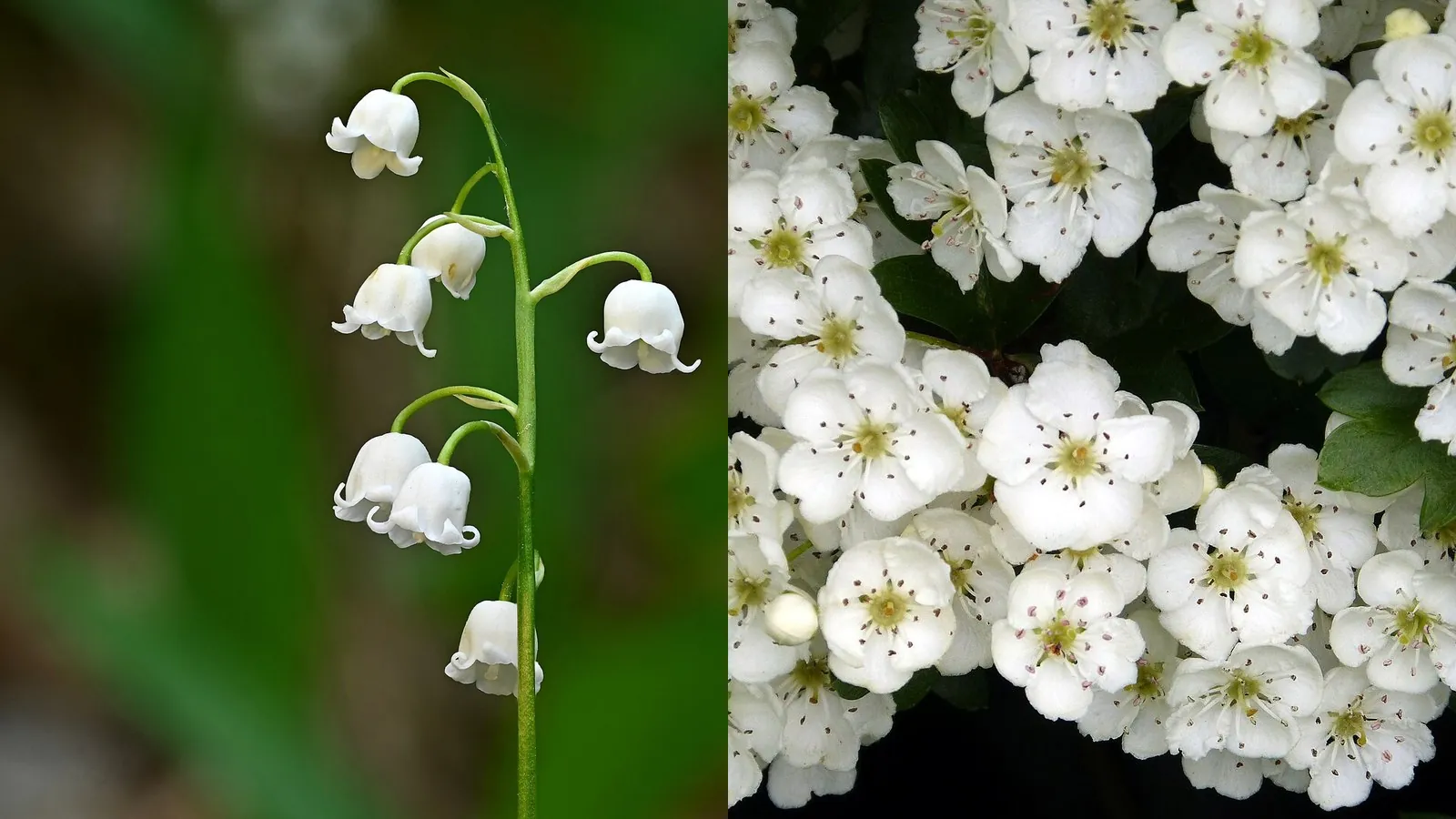
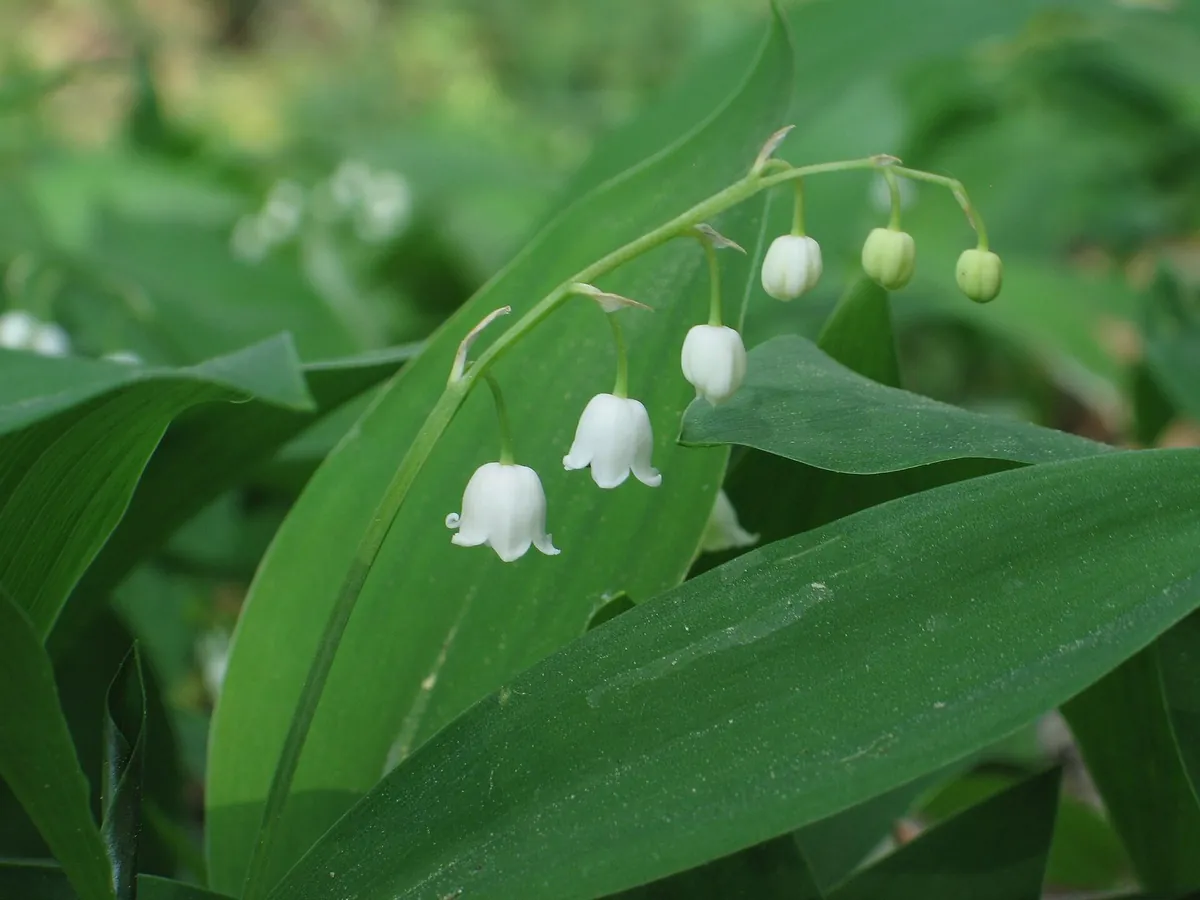
Lily of the valley is not a true lily. Botanists now place it in the asparagus family, Asparagaceae. Each plant sends up two or three broad, pointed leaves and one slender stem that carries 6 to 16 nodding white bells, all hanging to one side. The scent is sweet, clean and strong enough to fill a room from a single sprig.
Where It Comes From
The plant is native to cool woodlands across Europe and parts of Asia. It reached North American gardens with early settlers and has naturalized in shady spots in the Northeast and Midwest. In Finland it is the national flower. Perfumers have chased its scent for generations, and it remains one of the classic “white floral” notes in fine fragrance.
Flowers, Berries and Growth Habit
Flowers open from late April into June, depending on your climate. After the bells fade, a few orange-red berries form in summer. Below ground, the plant spreads by rhizomes that produce upright buds called pips. Each pip becomes a new leaf and flower stem, which is how one small clump turns into a carpet over the years.
Lily of the Valley Meaning and Symbolism
Lily of the valley stands for sweetness, humility, purity and the return of happiness. The small, downward-facing bells suggest modesty. The spring bloom time suggests joy coming back after a long winter.
In the Victorian Language of Flowers
Victorian flower dictionaries were unusually consistent about this one. Kate Greenaway’s Language of Flowers, published in 1884, gives lily of the valley the meaning “return of happiness.” Earlier French and English flower books say much the same. If you wanted to tell someone that life felt good again, this was the flower to send.
Religious and Folk Legends
In Christian legend the plant sprang from the tears of Mary at the cross, which earned it the name “Our Lady’s tears.” Another story says it grew where Eve wept after leaving Eden. Across northern Europe it was linked to spring festivals, luck and the promise of a good year.
Royal Wedding Bouquets
Lily of the valley has a long record in royal weddings. Grace Kelly carried it when she married Prince Rainier of Monaco in 1956. Catherine Middleton chose it for her 2011 wedding to Prince William, mixed with sweet William, hyacinth and myrtle. Queen Elizabeth II’s coronation bouquet in 1953 included it too. The flower’s meaning, its white color and its scent make it a natural choice for brides who want a classic, understated look.
May Day and the Muguet Tradition
In France, lily of the valley is called muguet, and May 1 is the Fete du Muguet. On that morning, street sellers and schoolchildren offer small sprigs, and friends and family exchange them as a wish for luck and happiness in the year ahead.
How the Custom Began
The story usually told is that in 1561 King Charles IX received a sprig of lily of the valley as a lucky charm. He liked the idea so much that he began giving a sprig to each lady of his court every spring. The custom spread through the Paris fashion houses in the early 1900s, and later merged with the May 1 Labor Day holiday, which is why the flower and the public holiday now share the same date.
Giving Muguet Today
A traditional gift is a sprig with 13 bells, which is said to bring the most luck. Sellers often tie a few stems with a ribbon or set a small rooted clump in a pot. If you want to borrow the custom for a May birthday, a single small bunch in a plain glass says more than a large arrangement.
Is Lily of the Valley Poisonous?
Yes, and this matters more than its gentle look suggests. Every part of the plant is poisonous: leaves, flowers, berries, roots and even the water in the vase.
What Makes It Toxic
NC State Extension lists cardiac glycosides and saponins as the toxic principle. Eaten in quantity, they can cause an irregular or slow pulse, stomach pain, diarrhea, low blood pressure and confusion. The plant can also cause contact dermatitis in sensitive people, so wear gloves when dividing it.
Keeping People and Pets Safe
- Keep the red summer berries out of reach of children, who may mistake them for something edible.
- The ASPCA lists lily of the valley as toxic to dogs, cats and horses. Signs include vomiting, a slow or irregular heartbeat and weakness.
- Do not let pets drink from a vase that has held the stems.
- If a person eats any part, call Poison Help at 1-800-222-1222. For a pet, call your veterinarian or the ASPCA Animal Poison Control Center at (888) 426-4435.
If you enjoy growing beautiful but toxic plants with care, our guide to the angel trumpet flower covers the same safe-handling habits for another spring and summer favorite.
How to Grow Lily of the Valley
Lily of the valley is one of the easiest shade plants to grow, as long as you give it the cool, moist conditions it had in its native woods. The main decision is where to put it, because once settled it does not like to leave.
Light, Soil and Zones
Plant in partial to full shade. Morning sun is fine in cool climates, but hot afternoon sun scorches the leaves. The soil should be moist, well drained and rich in organic matter, such as leaf mold or compost. Most references rate it hardy in USDA Zones 3 to 8. In Zones 8 and warmer it often goes dormant early in summer and may struggle in heat.
Planting Pips
Lily of the valley is usually sold as bare-root pips in fall or early spring, or as potted plants in spring. Set the pips about 1 to 1.5 inches deep with the pointed bud facing up, and space them 4 to 6 inches apart. Water well and mulch lightly. Plants take a season to settle, then flower reliably every spring.
- Fall planting: the best time in most of the US, while the soil is still warm.
- Spring planting: fine for potted plants. Keep them watered through their first summer.
- Forcing indoors: chilled pips can be potted in winter for fragrant flowers in a few weeks.
Spreading, Dividing and Control
This plant spreads. In good conditions a small clump becomes a dense ground cover that crowds out weaker neighbors, which is wonderful under trees and a nuisance in a small border. Dig and divide the rhizomes in fall every few years to keep it where you want it, and share the pips with friends. Where it must stay put, plant it inside a sunken pot or a bed with a hard edge.
Care Through the Year
- Water: keep the soil evenly moist in spring and early summer. Drought turns the leaves brown at the edges.
- Feed: a mulch of compost each fall is all it needs.
- Pests: few. Slugs may chew young leaves, and leaf spot can mark foliage in wet years.
- Cultivars: ‘Rosea’ has pale pink bells, ‘Albostriata’ has cream-striped leaves and ‘Bordeaux’ has larger flowers.
Hawthorn: May’s Second Birth Flower
Hawthorn is a small, thorny tree in the rose family, Rosaceae. The common hawthorn of European hedgerows is Crataegus monogyna. In Britain it is simply called “May” or “May blossom,” and its old names include whitethorn and quickthorn, from the quick-growing, living hedges it was planted to make.

Blossom, Thorns and Berries
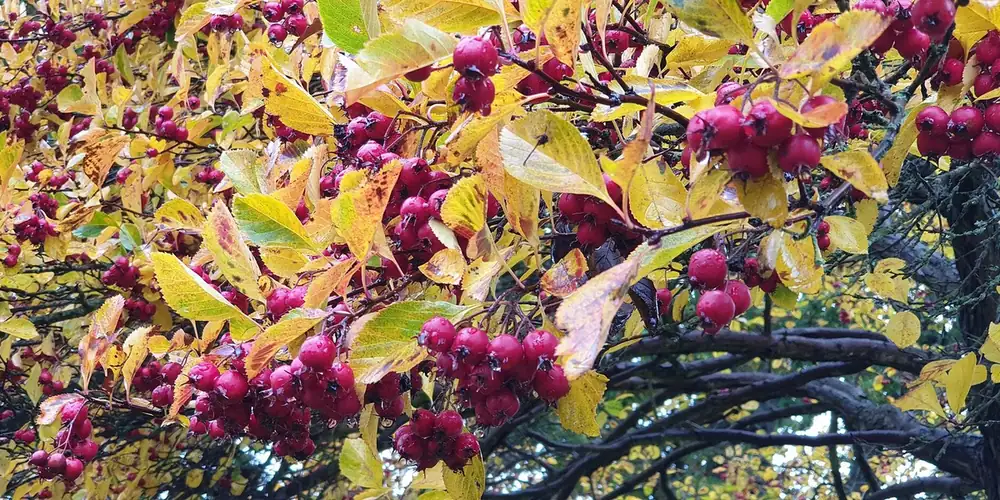
In May the whole tree covers itself in flat clusters of small, five-petaled white flowers with pink or dark red anthers. Each flower is only about half an inch across, but there are thousands. The scent is heavy and sweet with a slightly musky edge. In fall the flowers become red berries called haws, which hang on into winter and feed thrushes, waxwings and other birds.
Hawthorn Species for US Gardens
North America has dozens of native hawthorns. Washington hawthorn (Crataegus phaenopyrum) is a popular street and garden tree with glossy leaves, late white flowers and bright red fruit. Cockspur hawthorn (Crataegus crus-galli) has long thorns and good fall color, and a thornless form is available. English hawthorn (Crataegus laevigata) gives the famous double pink and red cultivars such as ‘Paul’s Scarlet’.
Hawthorn Meaning and Symbolism
Hawthorn stands for hope and supreme happiness. Greenaway’s 1884 flower dictionary lists it simply as “hope.” The ancient Greeks and Romans linked it to marriage and new life. In Celtic tradition it marked the boundary between this world and the next.
May Day and the May Tree
Hawthorn blossom was the flower of May Day in Britain and Ireland. People cut branches to decorate doorways and maypoles, and the Celtic festival of Beltane fell when the tree came into flower. The old rhyme “Ne’er cast a clout till May be out” is often read as advice to keep your winter clothes on until the hawthorn blooms.
Fairy Trees and Bad Luck Indoors
In Ireland a lone hawthorn in a field is a fairy tree, and many farmers still refuse to cut one down. Across Britain it was thought unlucky to bring the blossom into the house. There may be a practical reason. The scent contains a chemical also found in decaying matter, which once made people associate it with illness and death.
The Glastonbury Thorn
The most famous hawthorn in England is the Glastonbury thorn, a form of Crataegus monogyna that flowers twice a year, once in spring and again around Christmas. Legend ties it to Joseph of Arimathea, who is said to have planted his staff on Wearyall Hill. For centuries a sprig of winter blossom has been sent to the British monarch each December.
Hawthorn in the Hedgerow
Few trees have shaped the English countryside as much as hawthorn. Between the 1700s and the 1800s, English landowners planted thousands of miles of hawthorn hedges to enclose fields. The thorns kept livestock in, the dense growth sheltered wildlife, and the May blossom and fall haws turned every field edge into a seasonal display.
Haws: The Fall Berries
Haws are small red fruits, each with a single seed in common hawthorn. They are edible but mealy, and most people cook them into jelly, ketchup or syrup rather than eating them raw. Hawthorn fruit and leaves are also used in traditional herbal medicine for the heart. If you take heart medication, talk to your doctor before using any hawthorn product, because the two can interact.
How to Grow Hawthorn
Hawthorn is a forgiving tree. Give it sun and reasonable drainage, and it will grow almost anywhere, from a windy hillside to a city front yard.
Site and Soil
Plant in full sun for the best flowers and fruit. Hawthorn tolerates clay, chalk, sand and poor soil, and it shrugs off wind and salt spray. Common hawthorn is hardy in roughly USDA Zones 5 to 7, while many North American species and English hawthorn cultivars handle Zones 4 to 7. Expect a mature height of 15 to 30 feet and a similar spread.
Planting and Care
- Planting: set out container or bare-root trees in fall or early spring. Water deeply through the first two summers.
- Pruning: little is needed. Remove dead or crossing wood in late winter, and wear thick gloves because the thorns are long and sharp.
- Hedging: plant young whips 12 inches apart in a single or double row, and trim after flowering so you keep the blossom.
- Problems: fire blight, cedar-hawthorn rust and leaf spot can trouble some species in humid regions. Thornless, disease-resistant cultivars help.
A Note on Invasiveness
Common hawthorn has escaped gardens in the Pacific Northwest, where birds spread the seed into woodland edges and pastures. Oregon and Washington both treat it as an invasive plant. If you garden there, choose a native hawthorn such as black hawthorn (Crataegus douglasii) or Washington hawthorn instead.
Lily of the Valley vs Hawthorn at a Glance
| Feature | Lily of the valley | Hawthorn |
|---|---|---|
| Plant type | Low herbaceous perennial, 6 to 10 inches | Small deciduous tree or large shrub, 15 to 30 feet |
| Light | Partial to full shade | Full sun |
| Hardiness | USDA Zones 3 to 8 | USDA Zones 4 to 7, depending on species |
| Flowers | Nodding white bells on a one-sided stem | Flat clusters of small five-petaled flowers |
| Scent | Sweet and strong | Heavy, sweet, slightly musky |
| Fruit | Orange-red berries, poisonous | Red haws, edible when cooked |
| Spread | Rhizomes form a ground cover | Seeds spread by birds |
| Safety | All parts poisonous to people and pets | Long thorns; fruit safe in moderation |
May Birth Flower Bouquets and Gift Ideas
Both May birth flowers are short-lived once cut, so plan gifts around fresh sprigs, living plants or keepsakes that carry the symbol.
Bouquet Ideas
- A muguet posy: a dozen stems of lily of the valley with their own leaves, tied with white ribbon in a small glass.
- White on white: lily of the valley with a few other white flowers such as ranunculus or sweet pea for a classic bridal look.
- Hedgerow bunch: a short branch of hawthorn blossom with cow parsley and fresh green foliage, kept outdoors or on a porch if the family is superstitious.
Lily of the valley lasts only a few days in water, so cut it in the morning and keep the vase cool. Our guide to flower arranging for beginners covers conditioning and simple hand-tied posies. If you want to grow flowers for cutting, see how to plan a cut flower garden.
Gifts Beyond the Vase
- A pot of lily of the valley pips, ready to plant in a shady corner. Include a note about the toxicity.
- A young hawthorn tree for a gardener with space, or a thornless cultivar for a family yard.
- Lily of the valley fragrance, soap or candles, which capture the scent without the hazard.
- Jewelry or prints featuring lily of the valley bells, often paired with emerald, the May birthstone.
- A jar of homemade haw jelly, a traditional fall gift from a May tree.
May Birthstone, Zodiac Signs and Other May Flowers
Birth flowers sit alongside other May symbols, and together they make gift giving easy.
Emerald, the May Birthstone
The May birthstone is the emerald, a green form of beryl linked to rebirth, love and wisdom. Its color echoes the fresh green of lily of the valley leaves and new hawthorn foliage, so the two pair naturally in cards, jewelry and table settings.
Taurus and Gemini
People born May 1 to May 20 are Taurus, an earth sign often associated with loyalty, patience and a love of comfort. Those born May 21 to May 31 are Gemini, an air sign tied to curiosity and quick wit. Florists sometimes match Taurus with lush, scented flowers and Gemini with light, airy ones, which maps neatly onto lily of the valley and hawthorn.
Other Flowers Linked to May
May is also the month of peonies, lilacs, irises and the first garden roses. Lilies are sometimes listed as a May flower in older charts, mainly because of the name confusion with lily of the valley. For a wider look at what blooms when, browse our illustrated list of types of flowers.
May follows the April birth flowers, the daisy and sweet pea, the March birth flower, the daffodil, and the February birth flowers, the violet and primrose. Earlier still, the January birth flowers are the carnation and snowdrop.
Fun Facts About May’s Birth Flowers
- Lily of the valley is not a lily. It belongs to the asparagus family.
- The species name majalis means “of May,” which is how the flower got its month.
- A sprig of lily of the valley with 13 bells is said to be the luckiest gift on May 1 in France.
- Hawthorn’s old name quickthorn refers to a living hedge, not to speed of growth.
- The Glastonbury thorn flowers twice a year, in May and again around Christmas.
- Hawthorn is a member of the rose family, so its flowers share the five-petal plan of apple and cherry blossom.
May Birth Flower FAQs
What is the May birth flower?
May has two birth flowers. Lily of the valley (Convallaria majalis) is the primary May birth flower, and hawthorn (Crataegus) is the secondary flower. Lily of the valley stands for sweetness, humility and the return of happiness. Hawthorn stands for hope and supreme happiness. Both bloom in May in much of the US and Europe.
What does lily of the valley symbolize?
Lily of the valley symbolizes the return of happiness, sweetness, humility and purity. Victorian flower dictionaries, including Kate Greenaway’s Language of Flowers from 1884, list it as return of happiness. Its white bells and spring bloom time also link it to new beginnings, which is why it is a favorite in wedding bouquets.
Is lily of the valley poisonous?
Yes. Every part of lily of the valley is poisonous, including the flowers, leaves, red berries and even the water from a vase. The plant contains cardiac glycosides that can slow or disturb the heartbeat. Keep it away from children, dogs and cats, wear gloves when handling it and call Poison Help or your vet if any part is eaten.
Why is lily of the valley given on May 1?
In France, May 1 is the Fete du Muguet, when people give sprigs of lily of the valley (muguet) for luck. Tradition says the custom began in 1561, when King Charles IX received a sprig as a lucky charm and began giving one to the ladies of his court each spring. The custom later merged with the May 1 Labor Day holiday.
What does hawthorn symbolize?
Hawthorn symbolizes hope, happiness and protection. Greenaway’s Victorian flower dictionary lists hawthorn as hope. In British and Irish folklore it is the May tree, tied to May Day celebrations, fertility and the fairy world. Many people still consider it bad luck to bring hawthorn blossom indoors.
Where does lily of the valley grow best?
Lily of the valley grows best in partial to full shade, in cool, moist soil rich in organic matter. It is hardy in USDA Zones 3 to 8 and spreads by underground rhizomes, so give it room or plant it where it can be contained. In hot southern summers it may go dormant early, so keep it shaded and watered.
Can you grow hawthorn in a garden?
Yes. Hawthorn is a small, tough tree for full sun and almost any well-drained soil. Common hawthorn (Crataegus monogyna) suits USDA Zones 5 to 7 and makes a dense hedge or a specimen tree of 15 to 30 feet. In the Pacific Northwest it has become invasive, so gardeners there should choose a native hawthorn or a sterile cultivar instead.
What is the May birthstone and zodiac sign?
The May birthstone is the emerald, a green gem linked to rebirth and love. People born May 1 to May 20 fall under Taurus, and those born May 21 to May 31 under Gemini. A gift that pairs emerald green with white lily of the valley or hawthorn blossom covers all the May birth symbols at once.
Related flower guides
More guides you might enjoy.