January Birth Flower: Carnation and Snowdrop Meaning and Care
January's birth flowers are the carnation and the snowdrop. Here is what each means, how carnation symbolism changes by color, and how to grow both in a US garden.
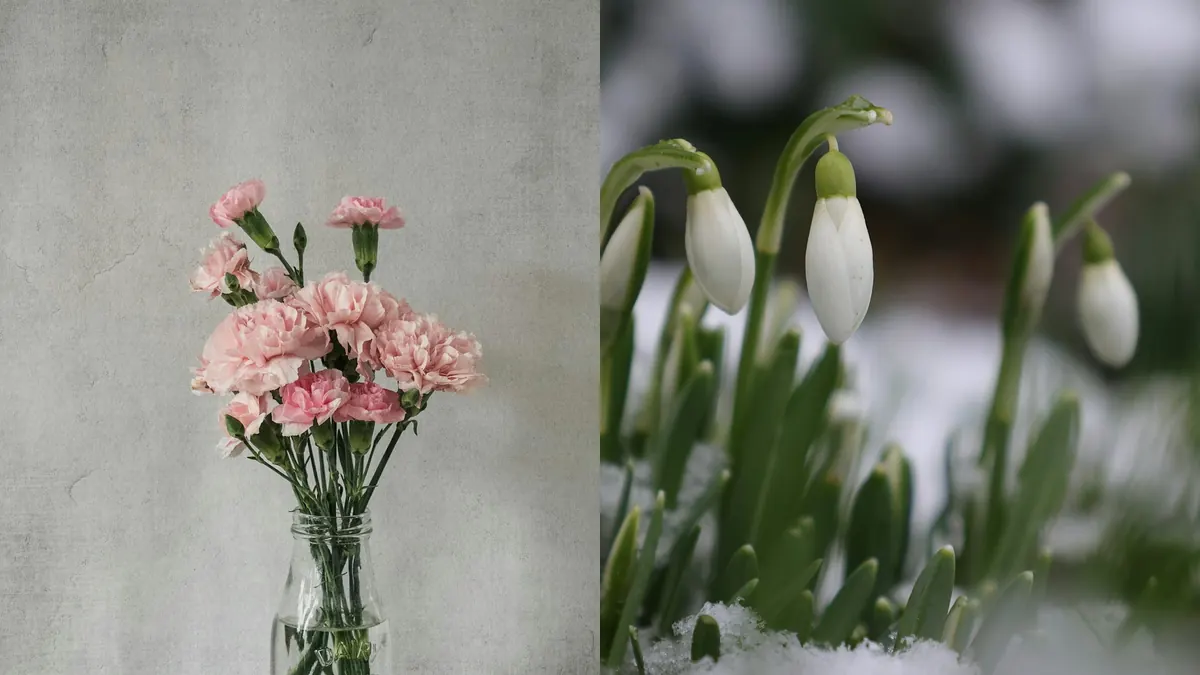
The January birth flower is the carnation (Dianthus caryophyllus), with the snowdrop (Galanthus nivalis) as the second flower. Carnations stand for love, admiration and devotion, and each color carries its own message. Snowdrops symbolize hope, purity and renewal after winter. Garden carnations are perennial in USDA Zones 6 to 9, while snowdrops are hardy in Zones 3 to 9.
January is the hardest month for flowers, so it makes sense that its birth flowers are both survivors. The carnation is a florist’s staple that lasts for weeks in a vase, and the snowdrop pushes its small white bells up through frozen ground before almost anything else wakes up.
One is ruffled, colorful and easy to buy all year. The other is tiny, pure white and grows best when you plant it yourself. Together they cover the two sides of a January birthday: warm celebration and the quiet promise of spring.
This guide explains what each flower means, how carnation symbolism changes by color, where both plants come from and how to grow them in a US garden. For every month in one place, see our birth month flowers guide.
Key takeaways
- The January birth flowers are the carnation (primary) and the snowdrop (secondary).
- Carnations symbolize love, admiration and gratitude, and their meaning shifts with color.
- Snowdrops symbolize hope, purity and renewal after winter.
- Garden carnations are perennial in USDA Zones 6 to 9; snowdrops are hardy in Zones 3 to 9.
- The ASPCA lists carnations as toxic to dogs, cats and horses, and snowdrop bulbs can upset a pet’s stomach.
What Is the January Birth Flower?
January has two birth flowers. The carnation is the traditional primary flower, and the snowdrop is the secondary flower. Most birth flower charts in the US list both, so either one is a fitting choice for a January birthday.
| Flower | Botanical name | Main meaning | Common colors | Bloom season |
|---|---|---|---|---|
| Carnation | Dianthus caryophyllus | Love, admiration, devotion | Red, pink, white, yellow, purple, striped | Late spring to summer outdoors; year-round from florists |
| Snowdrop | Galanthus nivalis | Hope, purity, renewal | White with green markings | Late winter to early spring |
Carnation: January’s Primary Birth Flower
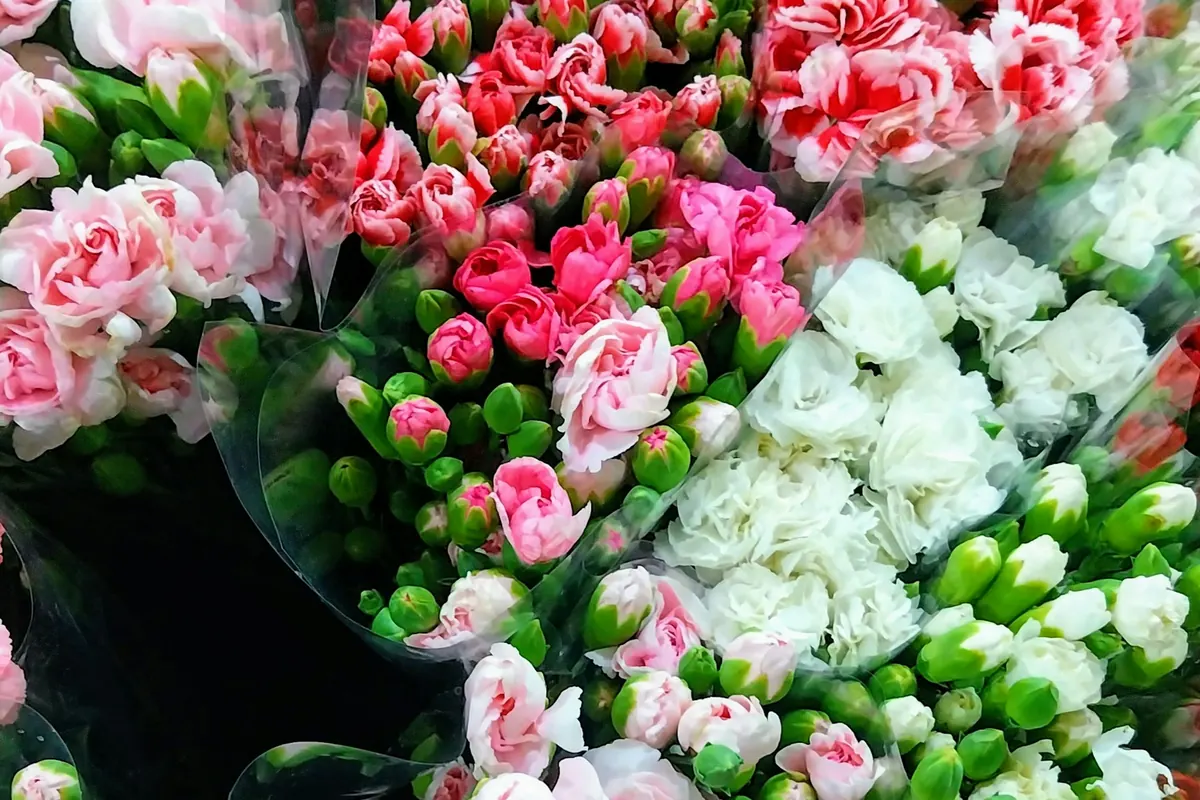
The carnation is a clove-scented member of the pink family, Caryophyllaceae. Its frilled petals grow in dense, rounded heads on stiff stems above narrow blue-gray leaves. Wild carnations come from the Mediterranean region, but the plant has been cultivated for around 2,000 years, so its exact natural range is uncertain.
Two kinds matter to most people. Florist carnations are tall, single-stemmed types grown in greenhouses for cut flowers, while border or garden carnations are shorter plants bred to grow outdoors. Spray carnations, sometimes called miniature carnations, carry several smaller blooms on each stem.
Carnations are close relatives of garden pinks and sweet William. They all belong to the genus Dianthus, which includes about 340 species, and many share the same spicy fragrance and fringed petal edges.
Carnation Meaning and Symbolism
In general, carnations stand for love, fascination, admiration and devotion. They are also the traditional flower for a first wedding anniversary, which ties them to new commitments.
Few flowers change meaning by color as much as the carnation does. The associations below come from the Victorian language of flowers and later florist tradition. Older flower dictionaries do not always agree, so treat them as a guide rather than a fixed code.
| Color | Meaning |
|---|---|
| Light red | Admiration and affection |
| Dark red | Deep love and romance |
| Pink | Gratitude and a mother’s love |
| White | Pure love, good luck and remembrance |
| Yellow | Disappointment or rejection in Victorian lore; cheer and friendship today |
| Purple | Unpredictability in older lore; often used for sympathy today |
| Striped | Refusal or regret |
| Green | Linked with St. Patrick’s Day and luck |
If you want a safe message for a January birthday, pink and light red carnations say thank you and I admire you without any risk of being misread. Skip yellow and striped carnations for anyone who knows the old flower language.
Carnations in History and Culture
Carnations appear in Greek writing from about 2,000 years ago. The Greek botanist Theophrastus is credited with the name Dianthus, usually translated as “divine flower” or “flower of Zeus,” from dios and anthos. Carl Linnaeus gave the carnation its formal name, Dianthus caryophyllus, in 1753.
The origin of the word carnation is less certain. One theory links it to the Latin corona, meaning crown or garland, because the flowers were woven into ceremonial crowns. Another traces it to caro, meaning flesh, after the pinkish color of the original flowers.
A Christian legend says the first carnations sprang up where the Virgin Mary’s tears fell during the Crucifixion. It is a story, not history, but it helps explain why pink carnations became tied to a mother’s love.
That link became official in the United States. In 1908, Anna Jarvis held a memorial service for her mother in Grafton, West Virginia, an event now counted as the first Mother’s Day observance, and she promoted the white carnation as its emblem. President Woodrow Wilson made Mother’s Day a national holiday in 1914. A custom grew of wearing a red or pink carnation for a living mother and a white one for a mother who had died.
Carnations hold civic meaning too. Ohio named the scarlet carnation its state flower in 1904 to honor President William McKinley, an Ohioan who often wore a red carnation on his lapel. In Portugal, the 1974 Carnation Revolution takes its name from the red carnations people placed in soldiers’ rifles.
Snowdrop: January’s Second Birth Flower
The common snowdrop is a small bulb in the amaryllis family. Each bulb sends up two or three strap-shaped leaves and a single nodding white flower about an inch long. The three outer petals are pure white, while the shorter inner petals carry a green mark near the notched tip.

Snowdrops are native to a wide band of Europe, from Spain east to Ukraine, and to parts of southwestern Asia. They have naturalized in several US states, including Pennsylvania, Virginia and North Carolina, where old plantings spread into woodland carpets.
The name Galanthus comes from the Greek gala, milk, and anthos, flower. The species name nivalis means “of the snow.” Both describe a plant that flowers when snow can still be on the ground, often in February and March, and as early as January in milder zones.
Snowdrop Meaning and Symbolism
Snowdrops symbolize hope, purity, renewal and consolation, because they are among the first flowers to appear after the darkest part of winter. In the Victorian language of flowers, a snowdrop meant hope or “friendship in adversity.”
Unlike carnations, snowdrops do not come in a rainbow of colors, so their symbolism is tied to white and to the small green markings on the inner petals:
- White: purity, innocence and a clean start, a natural fit for the first month of the year.
- Green tips: new growth and the return of life after winter.
- Double forms such as ‘Flore Pleno’: the same meanings, with fuller, frillier flowers that some gardeners prefer for gifting.
Some older British folklore gave the snowdrop a darker side. In parts of the country, people believed that bringing a single snowdrop indoors brought bad luck. This was superstition, but it shows how closely the flower was tied to both winter and death in rural tradition.
Snowdrop History, Folklore and Legends
Many people assume snowdrops are native to Britain or were brought there by the Romans. Current thinking is that they were probably introduced much later, perhaps around the early sixteenth century, and then spread through gardens, churchyards and woods.
Their link with the church calendar shows in old English names such as Candlemas bells and Mary’s tapers. Candlemas falls on February 2, when snowdrops are often in flower in England, and white flowers were associated with the purification of the Virgin Mary.
The best-known story is a legend about Adam and Eve. After they were sent out of Eden into a land of endless winter, an angel is said to have turned falling snowflakes into snowdrops to show Eve that spring would return. There is no historical basis for it, but it explains why the flower stands for hope.
Snowdrops also have a place in modern medicine. They contain galantamine, a compound used in a prescription drug for mild to moderate Alzheimer’s disease. The drug helps manage symptoms but is not a cure, and snowdrop plants themselves should never be eaten.
Carnation vs Snowdrop at a Glance
The two January flowers have very different needs, so compare them before you plant or buy.
| Feature | Carnation | Snowdrop |
|---|---|---|
| Plant type | Short-lived perennial, often grown as an annual | Bulb (perennial) |
| USDA zones | 6 to 9 | 3 to 9 |
| Height | About 1 foot for garden types; up to 3 to 4 feet for florist types | 3 to 6 inches |
| Light | Full sun, at least 6 hours | Part shade; sun in winter, shade in summer |
| Soil | Gritty, well-drained, neutral to slightly alkaline | Humus-rich, moist but well-drained |
| When to plant | Spring transplants after last frost | Dry bulbs in early fall, or “in the green” after flowering |
| Best for | Borders, containers, cut flowers | Woodland edges, under trees, naturalizing |
How to Grow Carnations
Garden carnations are perennial in USDA Zones 6 to 9, and many gardeners treat them as annuals because plants decline after two or three years. They like sun and cool summers. The NC State Extension Plant Toolbox notes that carnations dislike high heat, so gardeners in the Deep South often get the best show in spring and early summer.
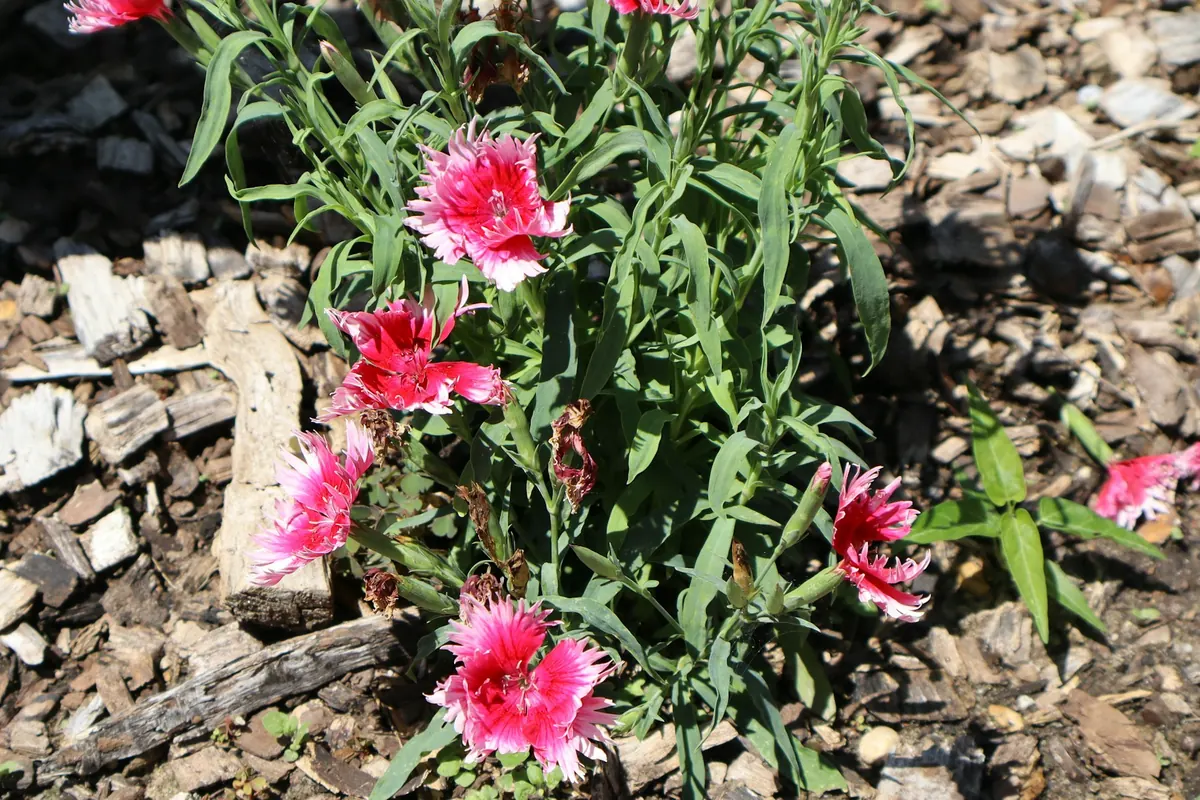
- Light: give plants at least six hours of direct sun. In hot regions, light afternoon shade helps.
- Soil: carnations want gritty, well-drained soil with some organic matter and a neutral to slightly alkaline pH. Heavy, wet clay leads to crown rot.
- Starting from seed: sow indoors 6 to 8 weeks before your last frost date, then transplant after frost has passed.
- Spacing: set garden types about 9 to 12 inches apart so air can move between plants.
- Watering: water at the base when the top inch of soil is dry. Keep mulch away from the crown.
- Pinching: pinch out the growing tip of young plants to get bushier growth and more flower stems.
- Deadheading: remove faded blooms to extend flowering. Tall florist types may need stakes or netting.
The most common reason carnations fail is wet soil around the crown, not cold. Rust and crown rot are the main disease problems, and both get worse in damp, crowded beds. Raised beds and containers with a gritty potting mix solve most of these issues.
How to Grow Snowdrops
Snowdrops are hardy in Zones 3 to 9 and need a cold winter to perform well. They are low-maintenance once settled and slowly spread by offsets and seed into wide drifts.
You can plant them two ways. Dry bulbs are sold in fall, and the University of Wisconsin-Madison Extension recommends planting them early in the fall, 3 inches deep and 3 inches apart, once nighttime temperatures fall to about 40 to 50°F. Dry snowdrop bulbs lose moisture quickly, so buy them as soon as they arrive in stores and plant right away.
The second method is planting “in the green,” which means moving or buying snowdrops just after they flower, while the leaves are still green. This tends to establish more reliably than dry bulbs. It is common in Britain and less common in the US, but some specialist nurseries ship snowdrops in the green in late winter or spring.
- Planting in the green: dig a hole deep enough for the roots and replant at the same depth as before. The line where the white stem turns green marks the old soil level.
- Light: plant under deciduous trees or shrubs, where snowdrops get sun in winter and shade once the canopy fills in.
- Soil: work leaf mold or compost into the planting area. Snowdrops like soil that stays lightly moist but never waterlogged.
- Foliage: let leaves die back on their own. In lawns, wait about six weeks after bloom before mowing.
- Dividing: lift and split crowded clumps as the foliage turns yellow, then replant right away.
- Buying: choose nursery-propagated bulbs. International trade in snowdrop bulbs is regulated under CITES to protect wild populations.
In the warmest parts of Zone 9, common snowdrops may fade out after a few years. The giant snowdrop, Galanthus elwesii, copes with warm weather better and is worth trying there. Pair snowdrops with other early bulbs, or see our white flowers guide for more white blooms to follow them through the year.
Are Carnations and Snowdrops Safe for Pets?
Neither January flower is pet safe. The ASPCA lists carnations as toxic to dogs, cats and horses. The toxic substance is not known, and the usual signs are mild stomach upset and mild skin irritation.
Snowdrops contain alkaloids, including lycorine, and the highest levels are in the bulb. The ASPCA groups snowdrops with plants that cause mild to moderate stomach upset, such as vomiting and diarrhea. Dogs that dig up and chew bulbs are at the greatest risk, so store spare bulbs out of reach.
Keep cut carnations where cats cannot nibble them. If your pet eats any part of either plant, call your veterinarian or the ASPCA Animal Poison Control Center at (888) 426-4435.
January Birth Flower Gift Ideas
Carnations are one of the easiest birth flowers to give in winter because florists stock them year-round. Recut the stems and change the water every few days and they often last around two weeks in a vase.

- A mixed bouquet of pink and white carnations for gratitude and good luck.
- A small pot of snowdrops in late winter, which can be planted outside after flowering.
- A bag of snowdrop bulbs in fall, for a gardener who will see the first blooms by their birthday.
- Carnation seeds or young plants, paired with a gritty potting mix and a terracotta pot.
- Jewelry, prints or cards featuring either flower, often paired with garnet, January’s birthstone.
- A winter windowsill bulb, such as an amaryllis, alongside a few carnations for extra color.
Want a softer, layered look in a bouquet? Add white ranunculus beside carnations of the same color. Choose pink or light red carnations for admiration, and white flowers for purity and a fresh start.
Fun Facts About January’s Birth Flowers
A few facts to write in a January birthday card:
- The color pink may be named after Dianthus flowers, whose frilled edges look as if they were cut with pinking shears.
- Ohio’s state flower is the scarlet carnation, chosen in 1904 in memory of President McKinley.
- Snowdrop leaves have hardened tips that protect the flower bud as it pushes up through cold soil.
- Collectors called galanthophiles pay high prices for rare snowdrop varieties with unusual green or yellow markings.
- The galantamine in snowdrops is used in a medicine prescribed for Alzheimer’s disease.
January is the start of the birth flower year. To compare it with the end of the series, read about the October birth flowers, marigold and cosmos, and the November birth flower, the chrysanthemum. Our list of types of flowers covers many more blooms by name.
January Birth Flower FAQs
What is the January birth flower?
January has two birth flowers: the carnation, its primary flower, and the snowdrop, its secondary flower. Carnations represent love and admiration, and snowdrops represent hope and renewal.
What does a carnation symbolize?
Carnations symbolize love, fascination, admiration and devotion. The exact meaning depends on color: pink stands for gratitude and a mother’s love, red for admiration or deep love, and white for pure love and good luck.
What does the snowdrop flower mean?
Snowdrops mean hope, purity and renewal. They are among the first flowers to bloom at the end of winter, so they stand for a fresh start and the return of spring.
What does planting snowdrops in the green mean?
Planting in the green means planting snowdrops just after they flower, while the leaves are still green, instead of as dry bulbs in fall. Replant them at the same depth they grew before, shown by the point where the white stem turns green.
Can carnations grow outside in winter?
Garden carnations are perennial in USDA Zones 6 to 9 and survive winter outdoors in well-drained soil. Their flowers appear from late spring through summer, so January carnations are usually florist-grown cut flowers.
Are carnations and snowdrops poisonous to cats and dogs?
Yes. The ASPCA lists carnations as toxic to dogs, cats and horses, causing mild stomach upset and skin irritation. Snowdrops, especially the bulbs, can cause vomiting and diarrhea, so call your vet if a pet eats either plant.
Related flower guides
More guides you might enjoy.