February Birth Flower: Violet and Primrose Meaning and Growing Guide
The February birth flowers are the violet and the primrose. Learn violet meaning by color, primrose symbolism, history, pet safety and how to grow both in a US garden.
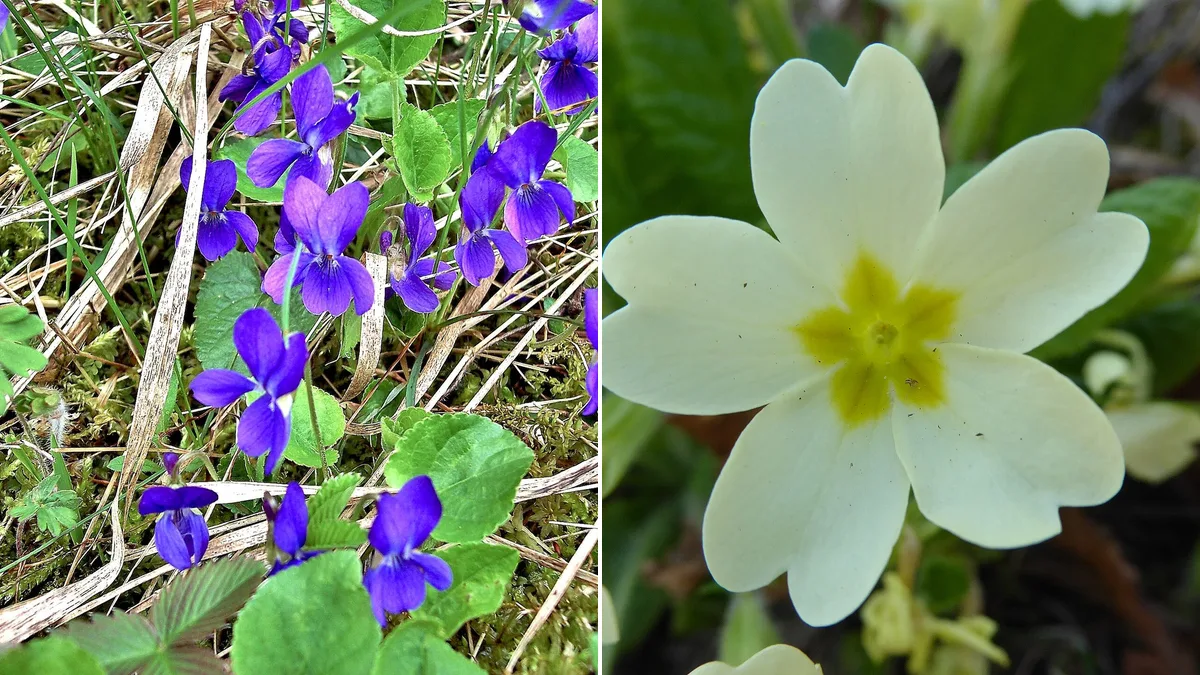
The February birth flower is the violet (Viola odorata), with the primrose (Primula vulgaris) as the second flower. Violets stand for modesty, faithfulness and humility, while primroses symbolize youth, young love and new beginnings. Sweet violets are hardy in USDA Zones 4 to 9 and primroses in Zones 4 to 8. Both like part shade and moist, rich soil.
February is short, cold and often gray, so its birth flowers are small and tough. The sweet violet hides fragrant purple flowers under heart-shaped leaves, and the primrose opens pale yellow blooms in the first mild days of the year.
Both plants stay low to the ground. Both prefer the dappled shade under trees. Together they capture what a February birthday feels like: quiet loyalty now, and the first real promise of spring.
This guide covers what each February birth flower means, where the symbolism comes from and how to grow both plants in a US garden. It also covers pests, pet safety and which parts are edible. For every month in one place, see our birth month flowers guide.
Key takeaways
- The February birth flowers are the violet (primary) and the primrose (secondary).
- Violets symbolize modesty, faithfulness and humility; primroses symbolize youth, young love and new beginnings.
- Sweet violets are hardy in USDA Zones 4 to 9, and common primroses in Zones 4 to 8.
- Both grow best in part shade and moist, well-drained soil rich in organic matter.
- The ASPCA lists primroses as toxic to dogs, cats and horses. Sweet violet flowers are edible and are often candied.
What Is the February Birth Flower?
February has two birth flowers. The violet is the traditional primary flower, and the primrose is the secondary flower. Most US birth flower charts list both, so either one suits a February birthday.
Some modern lists also add the iris, mostly because of its purple color. The violet and primrose remain the standard pair, and they are the flowers covered in this guide.
| Flower | Botanical name | Main meaning | Common colors | Bloom season |
|---|---|---|---|---|
| Violet | Viola odorata | Modesty, faithfulness, humility | Deep violet, white, pink | Late winter to spring |
| Primrose | Primula vulgaris | Youth, young love, new beginnings | Pale yellow; hybrids in many colors | Early to mid spring |
Where Do Birth Month Flowers Come From?
No official body chooses birth flowers. The lists grew out of old European customs, Victorian flower symbolism and later florist tradition. That is why charts sometimes disagree, especially for the secondary flower.
Violets and primroses earned their place for a simple reason. In much of Europe, they are among the first flowers to bloom as winter loosens its grip. A February birthday fits that early, hopeful season.
Violet: February’s Primary Birth Flower
The sweet violet is a low, clump-forming perennial in the violet family, Violaceae. It grows about 4 to 6 inches tall, with heart-shaped leaves and small five-petaled flowers. The lowest petal is larger and forms a short spur at the back.

Its common name comes from its fragrance. Viola odorata is the classic scented violet of perfumes and old-fashioned sweets, which sets it apart from the many unscented wild violets. Flowers are usually deep violet, though white and pink forms exist.
Sweet violet is native to Europe and Asia and has naturalized in parts of North America. It spreads by runners above the ground and by seed. Ants help, too. They carry the seeds away to eat a small oily appendage attached to each one.
Violet Meaning and Symbolism
In general, violets stand for modesty, faithfulness and humility. The idea of modesty comes from the way the small flowers hide among the leaves. Their scent gives them away long before you see them.
Like many flowers, violets carry different messages by color. The meanings below mix the Victorian language of flowers with later florist tradition. Older flower dictionaries do not always agree, so treat them as a guide rather than a fixed code.
| Color | Meaning |
|---|---|
| Purple or blue | Faithfulness, loyalty and love |
| White | Innocence, purity and modesty |
| Yellow | Rural happiness in Victorian lore |
| Pink | Affection and gentle love |
For a February birthday, a purple violet is the safest choice. It says you are loyal and you will stay that way. White violets work well for a new baby or a first birthday.
Violets in History and Culture
Violets have a long history in Europe. The ancient Greeks linked the flower with Athens, and the poet Pindar praised the city as “violet-crowned.” Violets were also grown for their scent and used to flavor food and drinks.
The flower’s most famous fan was probably Napoleon Bonaparte. When he was exiled to Elba in 1814, he is said to have promised to return when the violets bloomed. He came back in the spring of 1815, and his supporters used the violet as a secret sign of loyalty.
Victorian Britain loved violets as well. Posies of sweet violets were sold on city streets, and the flowers were candied for cakes and chocolates. That tradition of sugared violets is still alive today, especially in France.
Violets also hold civic meaning in the United States. Illinois, New Jersey, Rhode Island and Wisconsin all name a violet as their state flower. Most of these honor native violets, such as the common blue violet, rather than the European sweet violet.
Primrose: February’s Second Birth Flower
The common primrose is a low perennial in the primrose family, Primulaceae. It forms a rosette of crinkled, tongue-shaped leaves about 6 to 8 inches long. Each flower sits on its own slender stem in the middle of the rosette.
Wild primrose flowers are pale yellow, about 1 inch across, with a darker yellow eye and five notched petals. They have a light, sweet scent. Garden primroses bred from this species come in pink, red, purple, blue, white and bicolors.
Primula vulgaris is native to Europe and western Asia. Older books may list it under its former name, Primula acaulis. It flowers in early to mid spring, and in mild climates the first blooms can open in late winter.
Primrose Meaning and Symbolism
Primroses symbolize youth, young love and new beginnings, because they are among the first flowers of the year. In the Victorian language of flowers, a primrose meant “early youth.” Some flower lists also give it the message “I can’t live without you.”
The name itself carries this idea. Primrose comes from the medieval Latin prima rosa, meaning “first rose,” through Old French. The genus name Primula also comes from primus, the Latin word for first.
Garden primroses come in many colors, and modern gift guides often read them like this:
- Pale yellow: youth, cheer and the first light of spring.
- Pink and red hybrids: young love and affection.
- Purple and blue hybrids: loyalty, a natural partner for February violets.
The primrose is not a rose at all. The “first rose” name simply marks it as one of the first flowers of the season.
Primrose History, Folklore and Legends
Shakespeare used the primrose more than once. In Hamlet, Ophelia warns her brother not to tread “the primrose path of dalliance” while preaching virtue to her. The phrase “primrose path” still means an easy, pleasant road that leads to trouble.
The flower also has a political story. The British prime minister Benjamin Disraeli was closely linked with primroses. After his death on April 19, 1881, Queen Victoria sent a wreath of primroses and called them his favorite flowers.
His supporters later founded the Primrose League in 1883. April 19 became known as Primrose Day, when people wore primroses in his memory. The custom faded during the twentieth century.
Rural folklore gave primroses a magical side as well. In parts of Britain and Ireland, primroses were linked with fairies and laid on doorsteps in spring. These are customs and stories, not facts, but they show how the flower became tied to the turn of the seasons.
Violet vs Primrose at a Glance
The two February flowers share a lot. Both are short, both prefer part shade and both bloom early. They differ in color, meaning and how they spread.
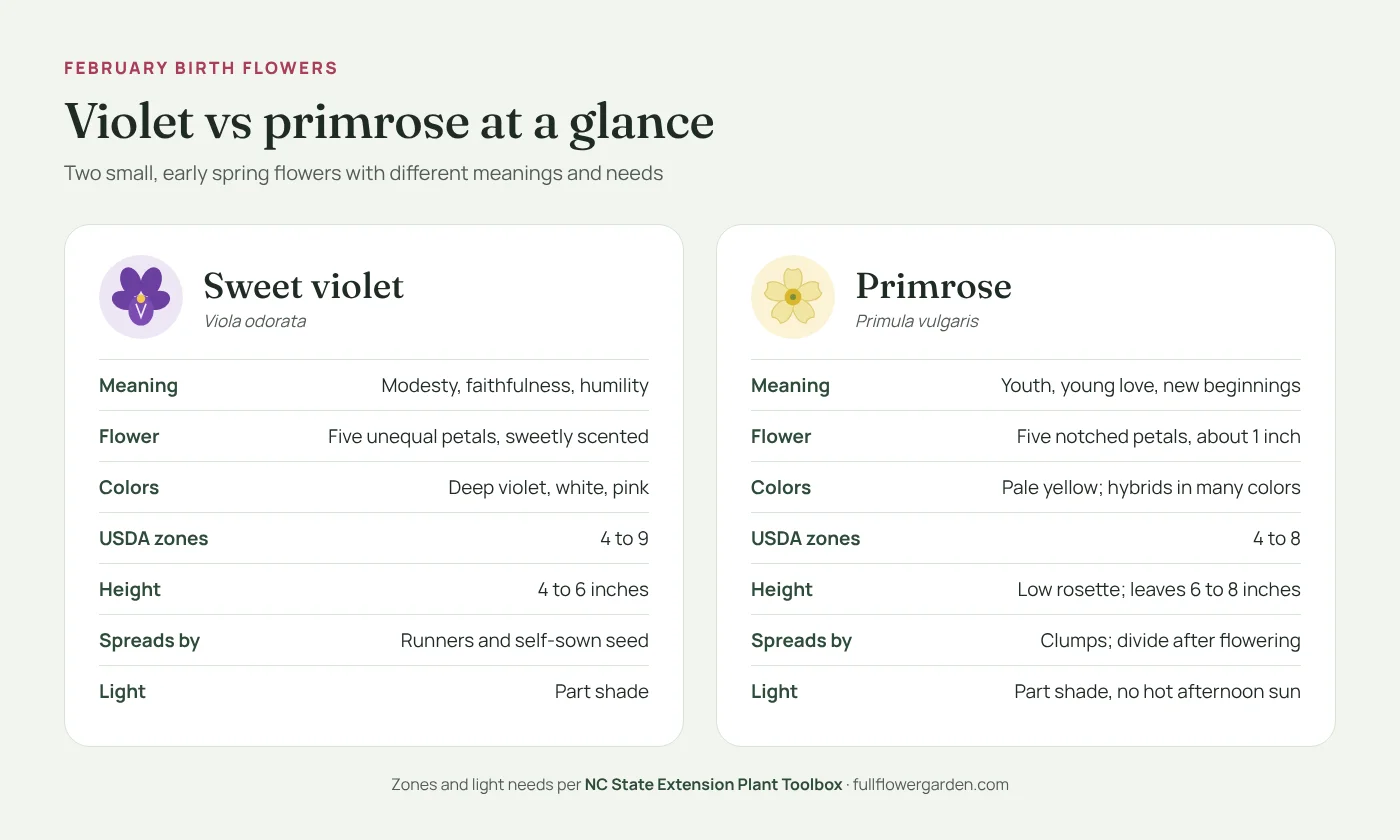
| Feature | Violet | Primrose |
|---|---|---|
| Plant type | Spreading perennial | Clump-forming perennial |
| USDA zones | 4 to 9 | 4 to 8 |
| Height | 4 to 6 inches | Low rosette; leaves 6 to 8 inches |
| Light | Part shade; dislikes full sun | Part shade; protect from hot afternoon sun |
| Soil | Moist, well-drained; tolerates acid to alkaline | Humus-rich, moist, well-drained |
| How it spreads | Runners and self-sown seed | Slowly widening clumps |
| Best for | Woodland edges, shady groundcover, edible flowers | Shady borders, containers, woodland gardens |
How to Grow Sweet Violets
Sweet violets are hardy in USDA Zones 4 to 9, according to the NC State Extension Plant Toolbox. They like dappled light or part shade, with about 2 to 6 hours of direct sun. They grow in clay, loam or sand and tolerate acid, neutral or alkaline soil.
- Light: plant under deciduous trees or on the shady side of a border. Full sun, especially in hot summers, scorches the leaves.
- Soil: work compost or leaf mold into the planting area. Violets want soil that stays moist but drains well.
- Planting: set young plants or divisions at the same depth they grew before, then water them in well.
- Watering: keep the soil lightly moist in spring and during dry spells. Mulch helps hold moisture.
- Dividing: lift and split clumps to make new plants, or pot up rooted runners.
- Tidying: trim runners and weak growth in late fall for a neater, showier spring display.
- Seed: violets self-sow freely, so expect seedlings around the parent plants.
The main thing to know about sweet violets is that they spread. In rich, moist soil they can become weedy and creep into lawns and paths. Give them a spot where a carpet of violets is welcome, or edge the bed so you can pull strays.
Later in the season, violets also make small flowers that never open. These still set seed, which is one reason violets turn up in unexpected places. Plants are listed as resistant to deer and rabbits, and they feed the caterpillars of fritillary butterflies.
How to Grow Primroses
Common primroses are hardy in Zones 4 to 8. They need dappled light or part shade and humus-rich, moist, well-drained soil with a near-neutral pH. In the Southeast, give them protection from hot afternoon sun.
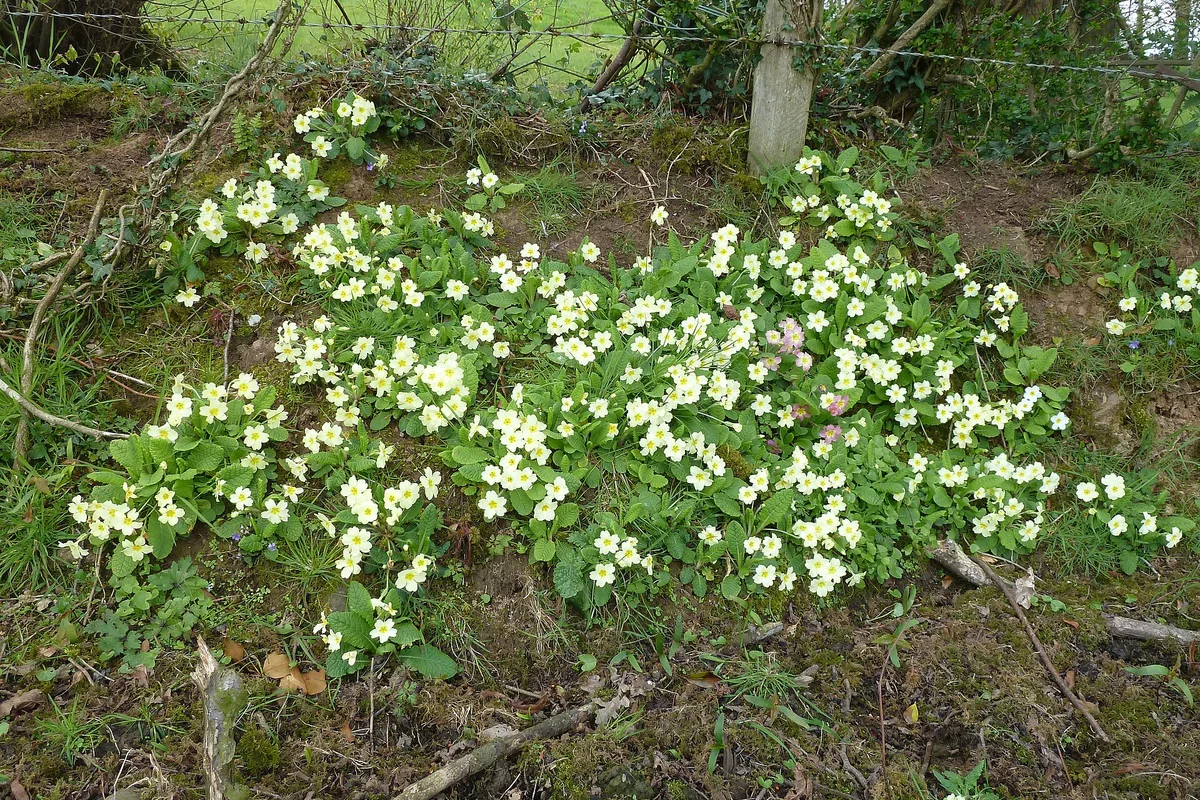
- Light: choose a spot with morning sun and afternoon shade, or the light shade of deciduous trees.
- Soil: add plenty of compost or leaf mold. Primroses dislike both dry soil and soggy, waterlogged ground.
- Planting: set plants with the crown level with the soil surface. Burying the crown can lead to rot.
- Watering: keep the soil consistently moist, especially in spring and through summer heat.
- Dividing: the best way to make more plants is to divide clumps after flowering, then replant right away.
- Containers: primroses suit pots and window boxes in spring. Move them into the garden once they finish blooming.
- Summer care: in hot, humid areas, the leaves may flag in summer. Shade and steady moisture help plants recover by fall.
Primroses are a good match for other spring flowers that like the same conditions, such as the columbine, which also enjoys light shade. Their flowers attract early bees, which is useful when little else is in bloom.
Common Pests and Problems
Both February flowers share a few pests. Most problems come from damp, crowded beds or hot, dry spells.
- Slugs and snails: the biggest threat to both plants, especially in early spring. Look for ragged holes in the leaves and slime trails.
- Aphids: common on primroses. They cluster on new growth and flower stems; a firm spray of water removes most of them.
- Red spider mites: both plants can get them in hot, dry weather. Look for fine webbing and pale, speckled leaves.
- Violet gall midge: causes violet leaves to roll up tightly at the edges. Remove and dispose of affected leaves.
- Leaf spots and powdery mildew: both plants can get them. Space plants for airflow and water at the base.
- Gray mold and root rot: primroses are prone to these in waterlogged or poorly drained soil.
Good drainage and steady, even moisture prevent more problems than any spray. Clear fallen leaves from crowns in spring so slugs have fewer places to hide.
Are Violets and Primroses Safe for Pets?
The two February flowers differ here. The ASPCA lists the primrose as toxic to dogs, cats and horses. The toxic substance is unknown, and the main sign is mild vomiting.
Sweet violet does not appear in the ASPCA’s toxic and non-toxic plant database, so the ASPCA gives no rating for it either way. Do not confuse it with the African violet, a different houseplant (Saintpaulia), which the ASPCA lists as non-toxic.
If your pet eats any part of either plant and seems unwell, call your veterinarian or the ASPCA Animal Poison Control Center at (888) 426-4435.
Can You Eat Violets and Primroses?
Sweet violets are a well-known edible flower. The NC State Extension Plant Toolbox notes that both the leaves and flowers can be eaten. The flowers are used to make candied violets, and their fragrance flavors candies, liqueurs and perfumes.
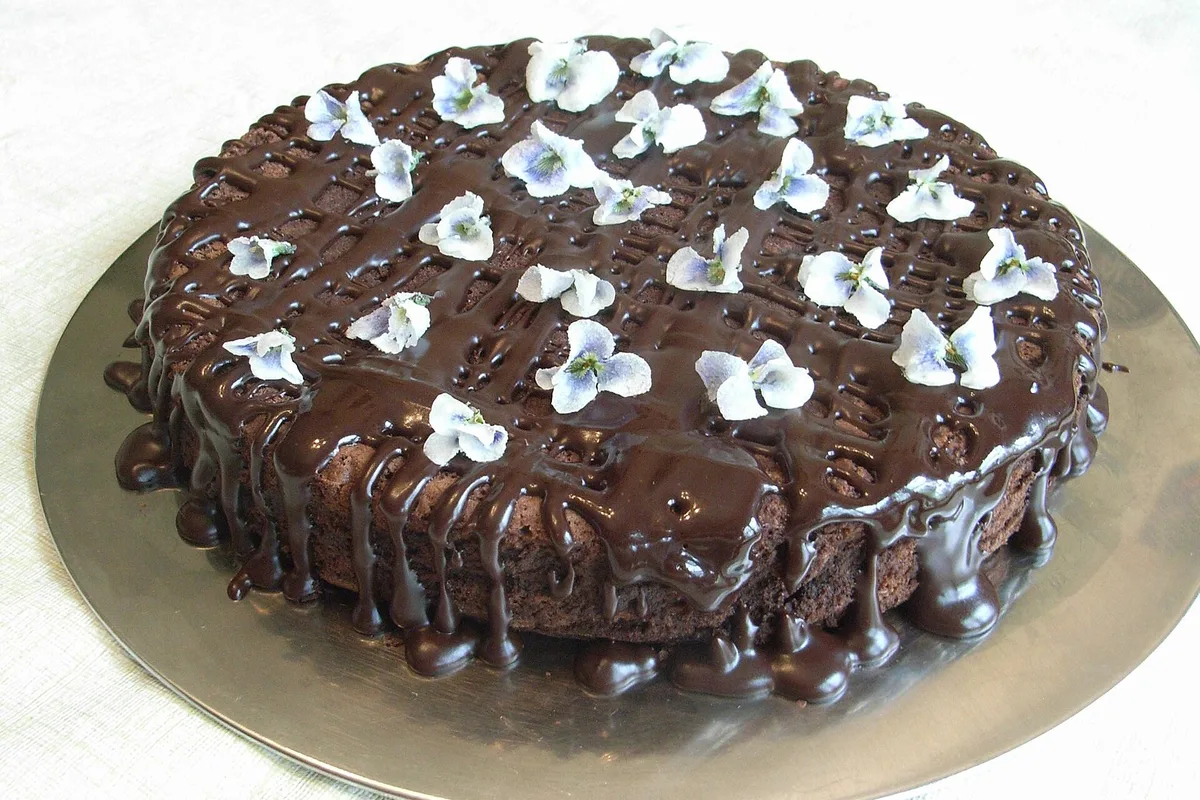
To candy violets, brush fresh flowers with beaten pasteurized egg white, dust them with superfine sugar and let them dry on parchment. Use them to decorate cakes, cupcakes and cookies.
Primroses need more caution. The NC State Extension Plant Toolbox lists primrose leaves as edible raw or cooked, but the plant is toxic to pets. Before you eat any flower, follow a few simple rules:
- Only eat plants you have identified with certainty.
- Never eat flowers from florists, garden centers or roadsides, since they may have been sprayed.
- Start with a small amount, and skip flowers if you have pollen allergies.
- Keep both plants away from pets, even if you use violets in the kitchen.
February Birth Flower Gift Ideas
Violets and primroses are easier to give as living plants than as cut flowers. Both are sold in small pots in late winter and early spring, right around February birthdays.
- A pot of sweet violets, which can be planted in a shady corner after flowering.
- A trio of colorful primroses in a basket or window box for instant spring color.
- A small box of candied violets for someone who loves baking or chocolate.
- Violet-scented soap, perfume or candles, which draw on the flower’s classic fragrance.
- Jewelry, prints or cards with either flower, often paired with amethyst, February’s birthstone.
- A cut bouquet in violet and soft yellow tones, or a plan to grow your own with our cut flower garden guide.
Choose purple violets for loyalty, and pale yellow primroses for youth and fresh starts. Together they make a thoughtful pairing for any February birthday.
Fun Facts About February’s Birth Flowers
A few facts to write in a February birthday card:
- The color violet is named after the flower, not the other way around.
- Many people notice that the scent of sweet violets seems to fade after a few sniffs. Compounds in the scent called ionones are thought to briefly dull the sense of smell.
- Violet seeds are spread by ants, which carry them off to eat a small oily appendage.
- Primrose means “first rose,” but the plant is not related to roses.
- Primrose Day, April 19, was once marked in Britain in memory of Benjamin Disraeli.
February follows the January birth flowers, the carnation and the snowdrop, which bloom in the same cold season. For flowers at the other end of the year, read about the October birth flowers and the November birth flower. Our list of types of flowers covers many more blooms by name.
February Birth Flower FAQs
What is the February birth flower?
February has two birth flowers: the violet, its primary flower, and the primrose, its secondary flower. Violets represent modesty and faithfulness, and primroses represent youth and new beginnings.
What does a violet symbolize?
Violets symbolize modesty, faithfulness and humility. By color, purple or blue violets stand for loyalty and love, white violets for innocence and purity, and yellow violets for rural happiness in Victorian flower lore.
What does the primrose flower mean?
Primroses mean youth, young love and new beginnings. The name comes from the Latin prima rosa, or first rose, because primroses are among the first flowers to bloom in spring.
When do violets and primroses bloom?
Sweet violets bloom from late winter to spring, depending on your climate. Common primroses bloom in early to mid spring, and in mild areas the first flowers can open in late winter.
Are violets and primroses poisonous to cats and dogs?
The ASPCA lists primroses as toxic to dogs, cats and horses, with mild vomiting as the main sign. Sweet violet is not listed in the ASPCA plant database, so call your vet if a pet eats either plant and seems unwell.
Are sweet violet flowers edible?
Yes. Sweet violet leaves and flowers are edible, and the flowers are often candied with egg white and sugar to decorate cakes. Only eat violets you have identified with certainty and that have not been sprayed.
Related flower guides
More guides you might enjoy.


Pingback: Blue Flowers: 35 True Blue Blooms and How to Grow Them