March Birth Flower: Daffodil Meaning and How to Plant Bulbs
The March birth flower is the daffodil, with the jonquil as an alternate. Learn daffodil meaning by color, myths and history, the 13 divisions, how to plant and force bulbs, aftercare and pet safety.

The March birth flower is the daffodil (Narcissus), with the jonquil as the traditional alternate. Daffodils symbolize rebirth, new beginnings, hope and joy, because they are among the first bright flowers of spring. Plant the bulbs in fall, about three times as deep as the bulb is tall, in full sun to part shade. They are hardy in USDA Zones 4 to 8.
March is the month when winter finally gives way. Right on cue, daffodils push up through cold soil and open their golden trumpets, often while the trees are still bare.
That timing is the whole story of the March birth flower. A daffodil is a promise that spring has arrived, which makes it a cheerful flower for anyone born at the turn of the season.
This guide covers what the daffodil and jonquil mean, the myths and history behind them and the main types you can grow. It also explains how to plant the bulbs, care for them after blooming, force them indoors and keep pets safe. For every month in one place, see our birth month flowers guide.
Key takeaways
- The March birth flower is the daffodil (Narcissus); the jonquil is the traditional alternate.
- Daffodils symbolize rebirth, new beginnings, hope and joy. Jonquils carry the Victorian message “I desire a return of affection.”
- Plant daffodil bulbs in fall, about 3 times as deep as the bulb is tall, in full sun to part shade.
- Daffodils are hardy in USDA Zones 4 to 8 and are resistant to deer and rabbits.
- Leave the leaves in place for about six weeks after flowering so the bulb can recharge.
- The ASPCA lists daffodils as toxic to dogs, cats and horses. The bulbs are the most poisonous part.
What Is the March Birth Flower?
The March birth flower is the daffodil. Many US birth flower charts also list the jonquil, a fragrant kind of daffodil, as a second or alternate flower. Both belong to the same genus, Narcissus, so either one suits a March birthday.
Unlike some months, March has no real disagreement over its flower. The daffodil is the standard choice, and the jonquil simply adds a sweeter-scented option.
| Flower | Botanical name | Main meaning | Common colors | Bloom season |
|---|---|---|---|---|
| Daffodil | Narcissus (many species and hybrids) | Rebirth, new beginnings, hope, joy | Yellow, white, orange, pink tones | Late winter to late spring |
| Jonquil | Narcissus jonquilla and its hybrids | Desire for returned affection | Mostly yellow; some white or bicolor | Mid to late spring |
Where Do Birth Month Flowers Come From?
No official body chooses birth flowers. The lists grew out of old European customs, Victorian flower symbolism and later florist tradition. That is why charts sometimes disagree from month to month.
The daffodil earned its place in March for a simple reason. In much of Europe and North America, it is one of the first large flowers to bloom each year. A March birthday lines up with that bright, hopeful season.
Daffodil: March’s Birth Flower
Daffodils are spring-flowering bulbs in the amaryllis family, Amaryllidaceae. Narcissus is the botanical name for the whole genus, and daffodil is the common name. The two words mean the same plants.
Each flower has six outer petals, called the perianth, around a central cup or trumpet called the corona. The corona is what gives a daffodil its classic look, and its size and shape are used to sort daffodils into groups.
According to the NC State Extension Plant Toolbox, daffodils grow 8 to 30 inches tall and 6 to 12 inches wide. Each planting blooms for two to three weeks. Across all cultivars, flowers can appear from late winter to late spring.
Daffodils are native to southern Europe and North Africa, and they have been grown in gardens for centuries. The wild daffodil of Britain, Narcissus pseudonarcissus, is still known there as the Lent lily because it blooms around Lent and Easter.
Daffodil Meaning and Symbolism
In general, daffodils stand for rebirth, new beginnings, hope and joy. The meaning comes straight from the calendar. The flowers appear as winter ends, so they became a natural symbol of renewal.
Older flower dictionaries add their own shades of meaning. Kate Greenaway’s Language of Flowers (1884) gives the daffodil the meaning “regard.” Some other Victorian lists link yellow daffodils with unrequited love, so meanings vary by source.
Modern florists also read daffodils by color. These meanings are tradition, not rules, but they help when you choose a gift:
| Color | Meaning |
|---|---|
| Yellow | Joy, optimism and the return of sunshine |
| White | Purity, peace and a fresh start |
| Orange or red cup | Enthusiasm, warmth and confidence |
| Pink cup | Affection and gentle love |
| Bicolor | Balance and harmony |
One old superstition is worth knowing. Giving a single daffodil is said to bring misfortune, while a full bunch brings happiness. For a March birthday, always give daffodils in a generous bunch.
Daffodils in History, Myth and Folklore
The botanical name comes from Greek myth. In the story, the beautiful youth Narcissus fell in love with his own reflection in a pool and wasted away beside it. A flower grew where he died, and it took his name.
Some writers point out that daffodil flowers often nod toward the ground, much like Narcissus gazing at the water. Others link the name to the Greek word narke, meaning numbness, which may refer to the plant’s toxic sap. The true origin is uncertain.
Daffodils hold a special place in Wales. The daffodil is a national emblem of Wales, and people wear it on St. David’s Day, March 1, the feast of the country’s patron saint. Welsh folklore also says that whoever spots the first daffodil of spring will have a year of wealth.
English poetry made the flower famous. William Wordsworth’s poem “I Wandered Lonely as a Cloud,” first published in 1807, describes a crowd of “golden daffodils” dancing beside a lake. It remains one of the best-known poems in the English language.
The daffodil means good fortune in other cultures too. In China, the fragrant Narcissus tazetta is grown indoors for the Lunar New Year, and a bloom on New Year’s Day is said to bring luck. In the United States, the American Cancer Society has long used the daffodil as its symbol of hope.
Jonquil: March’s Alternate Birth Flower
A jonquil is a specific kind of daffodil. True jonquils are Narcissus jonquilla and the hybrids bred from it. All jonquils are daffodils, but not all daffodils are jonquils.

Jonquils are easy to tell apart. They have narrow, rush-like leaves and carry several small flowers on each stem, where most daffodils carry one large bloom. Jonquils also have a strong, sweet fragrance.
In parts of the American South, people call almost any daffodil a jonquil. Botanically, though, the name belongs only to this fragrant group. Jonquils grow well in warm climates, which may explain why the name is so common there.
In Victorian flower language, the jonquil carried a romantic message: “I desire a return of affection.” It suits a March birthday gift for a partner, or for anyone you hope to grow closer to.
Daffodil vs Jonquil at a Glance
The two March flowers share the same basic needs. They differ mostly in leaves, flower count and scent.
| Feature | Daffodil | Jonquil |
|---|---|---|
| Botanical name | Narcissus (genus) | Narcissus jonquilla and hybrids |
| Flowers per stem | Usually one large bloom | Several small blooms |
| Leaves | Flat, strap-shaped | Narrow, rounded, rush-like |
| Fragrance | Light to none in many types | Strong and sweet |
| Main meaning | Rebirth, hope, new beginnings | Desire for returned affection |
| Best for | Bold drifts, borders, cut flowers | Fragrant beds, warm-climate gardens, pots |
Types of Daffodils: The 13 Divisions
Gardeners sort daffodils into 13 divisions, based on the Royal Horticultural Society’s classification. The division tells you roughly what a flower looks like before you buy it. Bulb catalogs often list it next to the variety name.
| Division | What it looks like |
|---|---|
| 1. Trumpet | One flower per stem; the trumpet is as long as the petals or longer |
| 2. Large-cupped | One flower per stem; the cup is more than one-third the petal length |
| 3. Small-cupped | One flower per stem; the cup is one-third the petal length or less |
| 4. Double | Doubled petals, a doubled cup or both |
| 5. Triandrus | Usually two or more nodding flowers with swept-back petals |
| 6. Cyclamineus | One flower, angled down, with strongly swept-back petals |
| 7. Jonquilla | Usually several fragrant flowers per stem; the true jonquils |
| 8. Tazetta | Clusters of small, very fragrant flowers on a stout stem |
| 9. Poeticus | White petals and a tiny cup, often green, yellow and red-rimmed |
| 10. Bulbocodium | The “hoop petticoat” type, with a wide cup and tiny petals |
| 11. Split corona | The cup is split into segments that lie back against the petals |
| 12. Miscellaneous | Daffodils that do not fit any other division |
| 13. Species and wild forms | Wild species, their variants and natural hybrids |
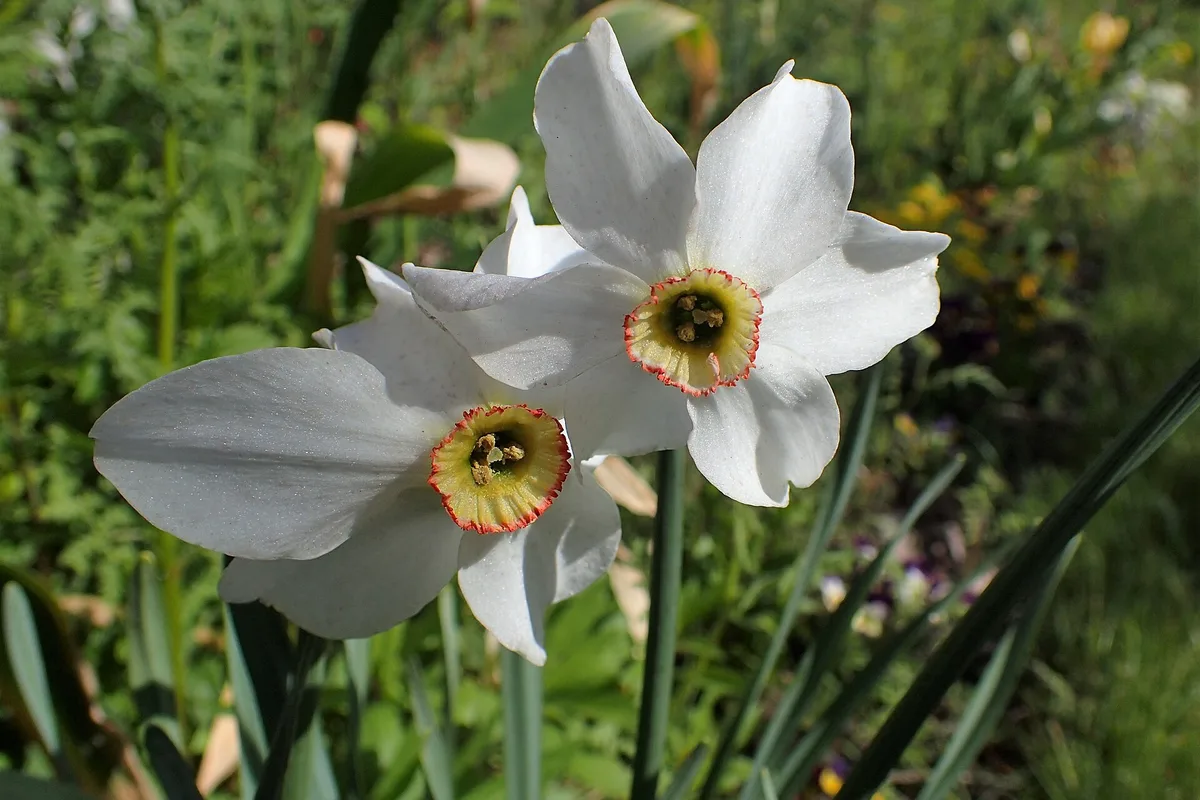
For a classic look, choose a trumpet or large-cupped daffodil. For scent, look at jonquils, tazettas and poeticus types. White daffodils pair beautifully with other pale blooms, and our guide to white flowers has more ideas.
How to Plant Daffodil Bulbs
Daffodils are among the easiest bulbs to grow. The NC State Extension Plant Toolbox lists them as hardy in USDA Zones 4 to 8. They grow in full sun to part shade and need soil that stays moist in spring but drains well.
Fall is the time to plant. NC State Extension advises planting once the soil has cooled below about 60°F. In colder zones that is often late September or October; in warmer zones it may be November. The bulbs need a long cold period over winter to bloom well.

- Site: choose a spot with at least half a day of sun. The flowers face the sun, so plant where you will see their faces.
- Soil: daffodils grow in clay, loam or sand, but they hate standing water. Wet soil leads to bulb rot.
- Depth: the Royal Horticultural Society advises planting at about 3 times the bulb’s height. For standard bulbs, that usually means 6 to 8 inches deep, measured from the base. Plant miniatures shallower.
- Spacing: set large bulbs 3 to 6 inches apart. Plant in groups of six or more for a natural look.
- Direction: put the flat base down and the pointed tip up. If you cannot tell, plant the bulb on its side.
- Water: water well after planting so the bulbs start making roots before the ground freezes.
- Feeding: a balanced fertilizer at planting helps future years’ blooms. This year’s flower is already formed inside the bulb.
Daffodils make good partners for other spring bulbs and corms. They look lovely with tulips, grape hyacinths and the rose-like ranunculus in milder zones.
Daffodil Aftercare: What to Do After Blooming
Good aftercare is the secret to daffodils that come back every year. Most of the work happens after the flowers fade.
- Deadhead: snap off faded flowers so the plant does not waste energy making seed.
- Leave the leaves: let the foliage turn yellow on its own. The RHS says this usually takes about six weeks after flowering ends.
- Do not knot or braid: tying the leaves cuts the light they need to refill the bulb for next year.
- Water in dry springs: keep the soil lightly moist while the leaves are green.
- Divide crowded clumps: if flowering drops off after several years, dig the clumps just after the foliage dies back. Split them and replant at the same depth.
Cutting the leaves too early is the most common reason daffodils stop flowering. To hide fading foliage, plant daffodils among perennials such as daylilies or hostas, which fill in as the bulb leaves die back.
How to Naturalize Daffodils in Grass or Woodland
Naturalizing means planting daffodils in grass or under trees and leaving them to spread for years. Daffodils are ideal for this because animals avoid them and the bulbs multiply over time.
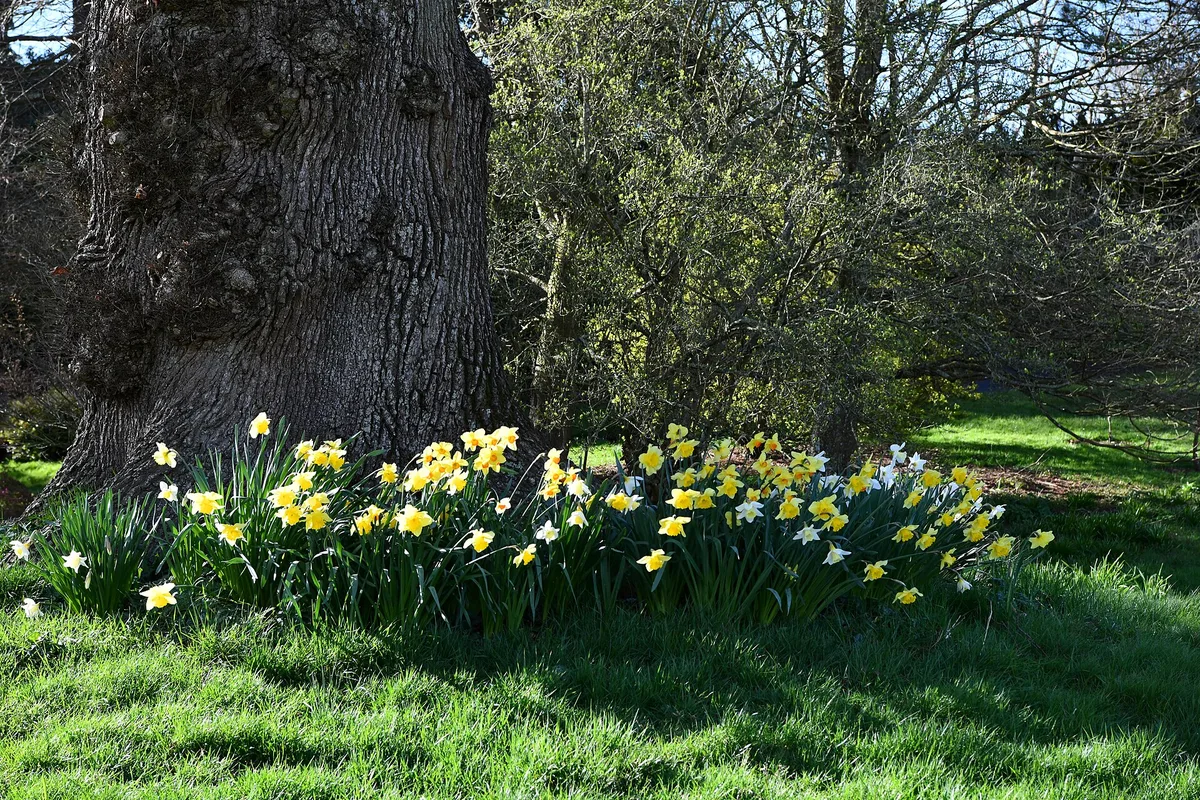
- Pick the right spot: lawns you can leave unmown in spring, slopes, orchards and the edges of woodland all work well.
- Plant in drifts: gently toss handfuls of bulbs and plant them where they land. This gives a natural, uneven pattern.
- Go under deciduous trees: the bulbs flower and grow their leaves before the trees leaf out and cast shade.
- Delay mowing: do not mow until the daffodil leaves have yellowed, about six weeks after flowering.
- Let some seed: in naturalized areas, you can leave some flowers to set seed if you want more plants.
The NC State Extension Plant Toolbox notes that daffodils are resistant to deer, rabbits and salt. That makes them one of the best bulbs for rural gardens and roadside beds.
How to Force Daffodils Indoors
Forcing means tricking bulbs into blooming early inside. Hardy daffodils need a cold period first, just as they would get outdoors in winter.
- Pot up: plant bulbs close together in a pot with drainage holes, with their tips at or just below the soil surface. A 6-inch pot holds 3 to 6 bulbs.
- Chill: keep the pots moist in a dark place at 35 to 45°F for 12 to 15 weeks, according to the Missouri Botanical Garden. An unheated garage or a refrigerator with no fruit inside works.
- Bring in: when roots show through the drainage holes and shoots are about 1.5 inches tall, move the pot to a cool room with indirect light.
- Bloom: move it to a bright window after a few days. Flowers usually open within 2 to 4 weeks.
- Choose good forcers: the Missouri Botanical Garden suggests ‘Dutch Master’, ‘Mount Hood’ and ‘Flower Record’.

Paperwhites (Narcissus papyraceus) are a different story. They need no chilling, so you can plant them in fall and enjoy fragrant flowers around the holidays. They pair well with other indoor bulbs such as amaryllis.
Forced hardy daffodils rarely bloom well a second time indoors. After flowering, keep them in a bright spot until the leaves die back, then plant them outside in fall. They may take a year or two to bloom again.
Common Pests and Problems
Daffodils have few serious problems. Most trouble comes from wet soil, damaged bulbs or one specific pest.
- Narcissus bulb fly: the large bulb fly (Merodon equestris) looks like a small bumblebee. Its larva, a creamy white maggot, eats out the center of the bulb. Infested bulbs rot or send up a few grassy leaves and no flowers.
- Basal rot: a fungal rot that starts at the base of the bulb, especially in warm, damp soil. Discard any bulb that feels soft.
- Bulb mites: tiny pests that attack bulbs already damaged by other problems or poor storage.
- Slugs and snails: they chew holes in leaves and flowers, mostly in wet spring weather.
- Blindness: plants make leaves but no flowers. Common causes include crowded clumps, foliage cut too early and bulbs planted too shallow.
To limit bulb fly, buy firm bulbs from a reputable supplier and firm the soil around plants after flowering. The RHS explains that this makes it harder for the female flies to lay eggs near the bulbs. Dig up and destroy any plants that show signs of attack in spring.
Are Daffodils Poisonous to Pets and People?
Yes. The ASPCA lists daffodils as toxic to dogs, cats and horses. The plants contain lycorine and other alkaloids. Signs include vomiting, drooling and diarrhea, and large amounts can cause tremors, low blood pressure, convulsions and heart rhythm problems.
The bulbs are the most poisonous part. Dogs that dig up freshly planted bulbs are at the greatest risk. Plant behind a barrier or in areas your dog cannot reach, and never leave spare bulbs lying around.
Daffodils are also toxic to people. NC State Extension notes that eating them can cause nausea, vomiting and diarrhea, and that handling the bulbs and stems can cause a skin rash. Wear gloves when planting, and store bulbs away from food, since they can be mistaken for onions.
If your pet eats any part of a daffodil, call your veterinarian or the ASPCA Animal Poison Control Center at (888) 426-4435. For a person, call Poison Help at 1-800-222-1222.
March Birth Flower Gift Ideas
Daffodils are easy to find in March, both as cut flowers and as potted bulbs. That makes them one of the simplest birth flowers to give on the day.
- A big bunch of cut daffodils. Remember the superstition: never give just one.
- A pot of blooming daffodils or miniature ‘Tete-a-Tete’ types, which can be planted in the garden after flowering.
- A bag of daffodil bulbs with a note to plant them in fall, a gift that returns every March.
- A pot of fragrant jonquils for someone who loves scented flowers.
- Jewelry, prints or cards with daffodils, often paired with aquamarine, March’s birthstone.
- A mixed spring bouquet, or a plan to grow your own with our cut flower garden guide.
If you mix daffodils with other cut flowers, condition them on their own first. Freshly cut stems release a sap that can shorten the vase life of other flowers. Stand them in water by themselves for several hours, then add them to the bouquet without recutting.
Choose yellow daffodils for joy and new beginnings, and jonquils for affection. Either one makes a bright, fitting gift for a March birthday.
Fun Facts About March’s Birth Flower
A few facts to write in a March birthday card:
- Narcissus is both the botanical name and the name of the Greek youth who fell in love with his reflection.
- Wales wears the daffodil as a national emblem on St. David’s Day, March 1.
- The British wild daffodil is called the Lent lily because it flowers around Easter.
- Gardeners recognize 13 divisions of daffodils, from big trumpets to tiny hoop petticoats.
- Deer and rabbits leave daffodils alone, which is why they spread so well in country gardens.
March follows the February birth flowers, the violet and the primrose, and the January birth flowers, the carnation and the snowdrop. Together they trace the first months of the gardening year. Our list of types of flowers covers many more blooms by name.
March Birth Flower FAQs
What is the March birth flower?
The March birth flower is the daffodil (Narcissus). The jonquil, a fragrant type of daffodil, is often listed as an alternate. Both symbolize spring, renewal and fresh starts.
What does a daffodil symbolize?
Daffodils symbolize rebirth, new beginnings, hope and joy, because they bloom as winter ends. Yellow daffodils stand for happiness, and white daffodils for purity and a fresh start. Tradition says to give them in a bunch, never as a single flower.
What is the difference between a daffodil and a jonquil?
Jonquils are one group of daffodils, Narcissus jonquilla and its hybrids. They have narrow, rush-like leaves and several small, strongly scented flowers on each stem. Most other daffodils have flat leaves and one large flower per stem.
When should I plant daffodil bulbs?
Plant daffodil bulbs in fall, once the soil has cooled below about 60°F. In colder zones that is usually late September or October, and in warmer zones it may be November. The bulbs need winter cold to bloom in spring.
How deep do you plant daffodil bulbs?
Plant daffodil bulbs about 3 times as deep as the bulb is tall, with the pointed tip facing up. For standard bulbs that usually means 6 to 8 inches deep, measured from the base. Space them 3 to 6 inches apart.
Should I cut back daffodil leaves after flowering?
No. Leave the leaves until they turn yellow, usually about six weeks after the flowers fade. The green leaves make food that refills the bulb for next year. You can remove the faded flowers right away.
Are daffodils poisonous to cats and dogs?
Yes. The ASPCA lists daffodils as toxic to dogs, cats and horses, and the bulbs are the most poisonous part. Signs include vomiting, drooling and diarrhea. Call your vet or the ASPCA Animal Poison Control Center if your pet eats any part of the plant.
Related flower guides
More guides you might enjoy.


Pingback: June Birth Flower: Rose and Honeysuckle Meaning and Care