How to Dry Flowers: Air Drying, Pressing and Silica Gel Methods
Learn how to dry flowers at home by air drying, pressing and silica gel. This guide covers when to pick, step by step methods, drying times, the best flowers for each method, borax, microwave and glycerin options, and how to store and display dried flowers so they keep their color.

You can learn how to dry flowers at home with three main methods. Air drying suits sturdy flowers like lavender and statice: hang small bunches upside down in a dark, dry room for 2 to 4 weeks. Pressing suits flat flowers and leaves, under heavy books for 2 to 4 weeks. Silica gel keeps roses and dahlias most lifelike in about 2 to 7 days.
Learning how to dry flowers lets you keep a wedding bouquet, a birthday rose or a summer of garden blooms long after fresh petals would have dropped. The process is simple. You remove the water from the flower slowly enough that it keeps its shape, and quickly enough that it does not rot or turn brown.
The right method depends on the flower. Papery everlastings almost dry themselves. Thin, flat blooms like pansies press beautifully. Full, many-petaled flowers such as roses and peonies need a drying agent like silica gel to hold their form.
This guide walks through all three main methods step by step, with drying times, the best flowers for each, and how to store and display the results. It also covers borax mixes, microwave drying and glycerin for foliage, plus the mistakes that ruin a batch.
Key takeaways
- Pick flowers on a dry morning, just before or at full bloom. Faded or damaged flowers look worse once dried.
- Air drying is the easiest method. Hang bunches of 3 to 5 stems upside down in a dark, dry, ventilated room for 2 to 4 weeks.
- Pressing is best for flat flowers, petals and leaves. Change the paper after the first week and leave them for 2 to 4 weeks in total.
- Silica gel gives the most lifelike results for roses, dahlias, zinnias and peonies, usually in 2 to 7 days.
- Blue indicator silica gel turns pink when it is full of moisture. Dry it in a low oven and reuse it for years.
- Keep dried flowers out of direct sun and humidity, or they fade and droop within months.
Which Flower Drying Method Should You Use?
Each method removes water in a different way, so each one suits a different kind of flower. Use the shape of the bloom as your guide. Sturdy, papery and small-flowered stems air dry well. Thin, flat flowers press well. Thick, layered and fleshy flowers need a desiccant, a dry material that pulls moisture out while it holds the petals in place.
| Method | Best for | Drying time | Result | Cost |
|---|---|---|---|---|
| Air drying | Lavender, statice, strawflower, yarrow, baby’s breath, hydrangea | 2 to 4 weeks | Natural, slightly shrunken, muted color | Almost free |
| Pressing | Pansies, violas, ferns, cosmos, single petals, leaves | 2 to 4 weeks | Flat, delicate, good color | Almost free |
| Silica gel | Roses, peonies, dahlias, zinnias, ranunculus, daisies | 2 to 7 days | Full 3D shape, closest to fresh color | Moderate, reusable |
| Borax and cornmeal | Zinnias, marigolds, daisies, chrysanthemums | 1 to 2 weeks | Good shape, slightly duller color | Low |
| Microwave with silica gel | Small to medium flowers with thin petals | 1 to 3 minutes plus a day of rest | Bright color, fast | Moderate |
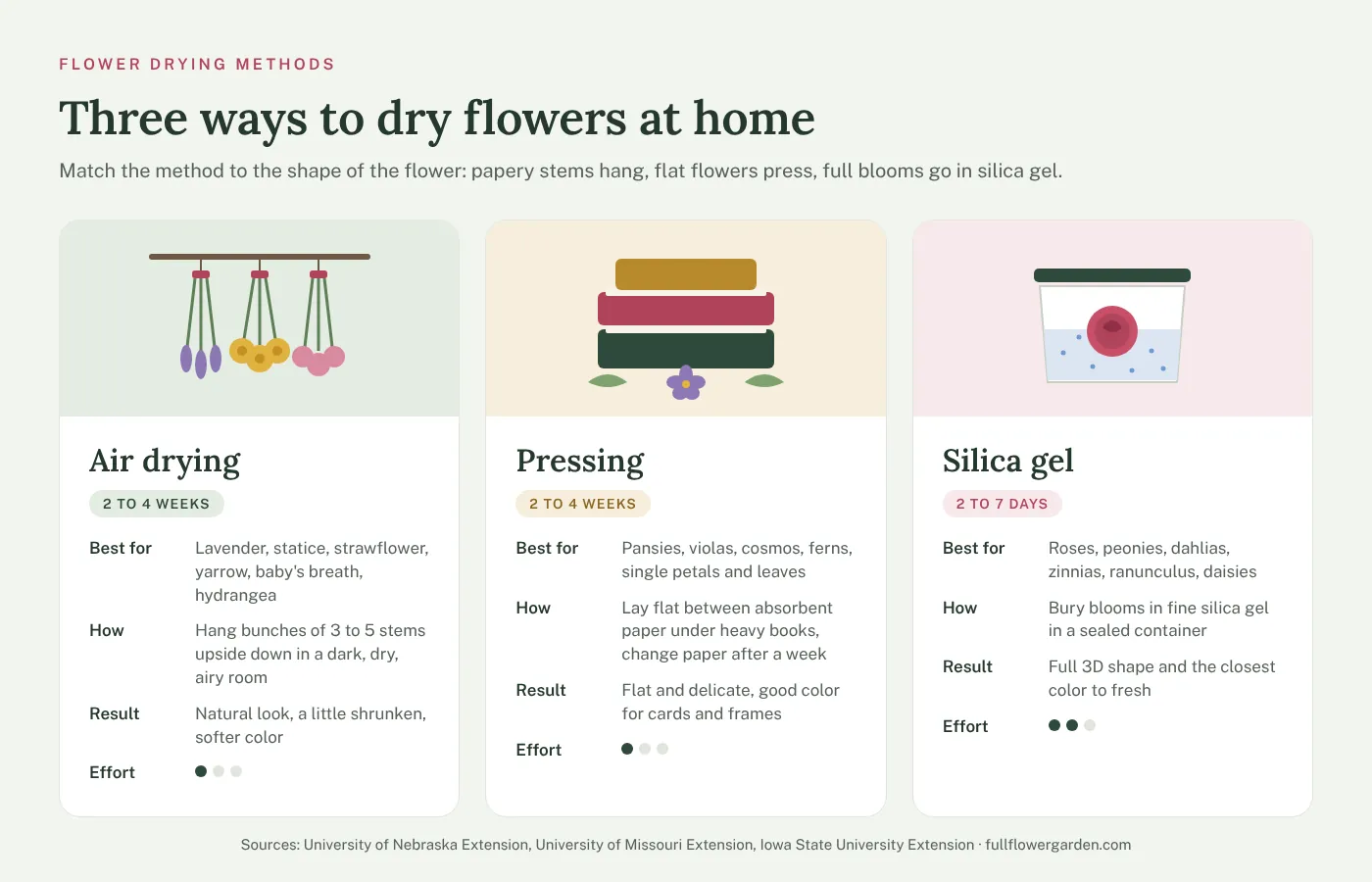
Match the Method to the Flower Shape
A quick rule works for most gardens. If the flower already feels a little papery, hang it. If it is flat or you want a flat result, press it. If it is round, layered or juicy, bury it in silica gel. Some flowers, like roses, can go either way: air dried roses shrink and darken, while silica gel roses keep their full cup shape.
How Long Each Method Takes
Drying time depends on the size of the flower, the thickness of the stems and the humidity of the room. A small bunch of lavender in a warm attic can be ready in under two weeks. A thick hydrangea head in a cool basement may take a month or more. Silica gel is the fastest home method that still gives natural results.
When and How to Pick Flowers for Drying
Good dried flowers start with good fresh flowers. Drying does not hide flaws. A small tear, a brown edge or an insect hole becomes more obvious once the petal shrinks.
Pick at the Right Stage
Cut most flowers just before they reach full bloom, when the color is at its strongest. Flowers keep opening a little as they dry, and an already fading bloom will drop its petals. Everlastings such as strawflower are best picked when the outer petals have opened but the center is still tight. Hydrangeas are the exception: leave them on the plant until the petals start to feel papery in late summer.
Pick on a Dry Morning
Harvest late in the morning, after the dew has dried but before the hottest part of the day. Wet petals are more likely to mold and brown. Pick about twice as many stems as you think you need, since some will not survive the process. If you grow your own, a cut flower garden gives you a steady supply of stems to experiment with.
Prepare the Stems
Strip the leaves from the lower stems straight away, because leaves hold moisture, slow drying and often shrivel badly. Put the stems in water if you cannot start drying within an hour. For silica gel, cut the stem to about 1 inch below the flower head. You can add a wire stem later.
How to Air Dry Flowers
Air drying is the oldest and easiest way to dry flowers. It needs no special materials and works for a long list of garden flowers. The trade-off is that flowers shrink a little and colors soften.
What You Need
- Rubber bands, which tighten as the stems shrink. String or ribbon loosens and lets stems slip out.
- A hanger, a rod, a drying rack or a nail in a beam.
- A dark, dry, well-ventilated space, such as an attic, a spare room or a dry shed.
- Paper bags, if you want to catch falling seeds or petals.
Step by Step
- Strip the foliage. Remove the leaves from the stems so air can move freely.
- Make small bunches. Group 3 to 5 stems, or up to about 10 thin stems such as lavender. Large, tight bunches dry slowly in the center and can mold.
- Secure the stems. Wrap a rubber band twice around the ends of the stems.
- Hang upside down. Hang each bunch head down from a hanger or rod, with space between bunches. Gravity keeps the stems straight and the heads upright once you turn them over.
- Keep it dark and dry. Direct light bleaches color, and humidity slows drying and invites mold.
- Check after 2 weeks. The flowers are ready when the petals feel crisp and the stems snap cleanly. Most take 2 to 4 weeks.

Best Flowers for Air Drying
These flowers hold their shape and much of their color when hung:
- Everlastings: strawflower, statice, globe amaranth and paper daisy.
- Herbs and spikes: lavender, larkspur, salvia, celosia and goldenrod.
- Airy fillers: baby’s breath, yarrow, sea lavender and grasses.
- Others: roses, bells of Ireland, protea, nigella seed pods and poppy seed heads.
Blue and yellow flowers usually keep their color best when air dried. Many pinks fade to a soft antique shade, and white flowers can turn cream.
Drying Large Heads Upright
Very large or heavy flowers, such as hydrangea and peony, should hang one stem at a time so the heads do not crush each other. Hydrangeas also dry well standing upright in a vase with an inch or two of water. Let the water evaporate without topping it up, and the heads dry slowly over 1 to 3 weeks with less shriveling.
How to Press Flowers
Pressing flattens flowers as it dries them, which makes them perfect for cards, frames, bookmarks and phone cases. The color often stays brighter than with air drying, because the flower dries quickly between absorbent layers and away from light.
Choose Flat Flowers and Leaves
Flowers with one layer of petals press best. Good choices include pansies, violas, cosmos, larkspur, single daisies, hydrangea florets, forget-me-nots and ferns. For a thick flower like a rose, press individual petals rather than the whole bloom, or cut the flower in half from top to bottom.
Pressing in a Book
- Pick a heavy book you do not mind marking, since moisture can wrinkle the pages.
- Line a page with absorbent paper, such as blotting paper, plain newsprint or coffee filters. Avoid glossy paper, which traps moisture.
- Arrange the flowers face down, without overlapping, and away from the spine.
- Cover and close. Add a second sheet of paper, close the book and stack more books or a brick on top.
- Change the paper after a week. Swap in fresh, dry sheets to stop mold and browning.
- Wait 2 to 4 weeks in total. The flowers are done when they feel dry and papery and lift off the paper without curling.

Using a Flower Press
A wooden flower press works the same way, with layers of cardboard and blotting paper held tight by corner screws. It applies more even pressure than books, so flowers come out flatter. Tighten the screws a little more every few days as the flowers shrink, and keep the press in a warm, dry room.
Faster Pressing With an Iron
For a quick result, place the flower between two sheets of parchment paper and press with a dry iron on a low setting. Do not use steam. Hold the iron in place for 10 to 15 seconds, lift it, let the paper cool and repeat until the flower is dry. Colors can darken slightly, so test one bloom first.
How to Dry Flowers With Silica Gel
Silica gel gives the most lifelike results of any home method. The fine crystals surround every petal, support its shape and pull moisture out fast. Roses, peonies, dahlias, zinnias, ranunculus and even garden mums come out looking close to fresh.
What Silica Gel Is
Flower drying silica gel is a fine, sandy desiccant sold at craft stores. It is not the same as the bead packets found in shoe boxes, which are too coarse. Many brands include blue indicator crystals that turn pink when the gel is full of moisture. It costs more than borax mixes, but it can be dried and reused for years.
Step by Step
- Choose a container with a tight lid, such as a plastic food storage box or a cookie tin, deep enough to cover the flowers.
- Add a base layer of 1 to 2 inches of silica gel.
- Trim the flowers, leaving about 1 inch of stem, and remove the leaves.
- Place the flowers into the gel so they do not touch each other or the sides.
- Cover slowly. Spoon or pour the gel around and between the petals first, then over the top, until each flower is buried by about an inch.
- Seal the lid and leave the container in a dry place.
- Check after 2 days. Tip the container gently to pour off some gel. Petals should feel dry and crisp, like paper.
- Remove and clean. Lift the flowers out carefully and brush off any crystals with a soft artist’s brush.

Placing Flowers by Shape
- Flat-faced flowers such as daisies, zinnias and cosmos: place them face up and work the gel under the petals.
- Cup and round flowers such as roses, peonies and ranunculus: place them face up and fill the center before covering the outside.
- Spikes such as snapdragons, larkspur and lilacs: lay them on their sides on the base layer.
- Trumpets such as daffodils: lay them on their sides and fill the trumpet gently.
How Long It Takes
Small, thin flowers such as pansies and violas can be ready in 2 to 3 days. Roses and zinnias usually take 3 to 5 days, and dense flowers such as peonies and large dahlias can take up to a week. Do not leave flowers in silica gel much longer than needed. Over-dried petals turn brittle and shatter.
Drying and Reusing the Gel
When most of the crystals have turned pink, spread the gel about half an inch deep on a baking sheet. Heat it in an oven at 225 to 250°F for 1 to 2 hours, stirring now and then, until the blue color returns. Let it cool in a sealed container so it does not soak up moisture from the air.
Safety Tips
Silica gel is not poisonous in the way many chemicals are, but the fine dust can irritate your nose, throat and eyes. Pour it slowly, work in a ventilated space and consider a dust mask. Keep it away from children and pets, and do not use the same containers or baking sheets for food afterward.
Other Ways to Dry Flowers
A few more methods are worth knowing, especially if you want to save money or get results fast.
Borax and Cornmeal
A mix of borax and fine white cornmeal is a cheap alternative to silica gel. Recipes vary from equal parts to 1 part borax with 3 parts cornmeal. Use it the same way as silica gel, but in an open box rather than a sealed one, and allow 1 to 2 weeks. It suits sturdy flowers such as zinnias, marigolds and daisies. Results are good, but colors are a little less bright.
Microwave Drying
Microwaving speeds up silica gel drying from days to minutes. Bury the flowers in gel in an uncovered, microwave-safe dish and place a cup of water in the microwave beside it. Heat thin flowers for about 1 minute and dense ones for up to 3 minutes, checking often. Then leave the dish to stand for 12 to 24 hours before you uncover the flowers. Use a dish you will never use for food again.
Glycerin for Leaves and Foliage
Glycerin does not dry plant material. It replaces the water in leaves, so they stay soft and supple instead of crisp. Mix 1 part glycerin with 2 parts hot water, stand freshly cut stems of eucalyptus, magnolia, beech or other sturdy foliage in 3 to 4 inches of the mix, and leave them for 2 to 3 weeks. The leaves usually turn bronze, olive or brown.
How to Keep Dried Flowers Looking Their Best
Dried flowers are fragile, but with a little care they can stay attractive for a long time.
Avoid Sun, Steam and Damp
Direct sunlight fades dried flowers faster than anything else. Keep displays away from sunny windows. Bathrooms and kitchens are poor spots too, because steam makes petals soak up moisture, droop and grow mold.
Seal Delicate Flowers
A light coat of unscented hairspray or a clear matte floral sealant helps petals resist moisture and stops them shedding. Spray outdoors from about a foot away. This is most useful for silica gel and microwave dried flowers, which take moisture back from the air quickly.
Store Them Properly
Keep dried flowers you are not using in a cardboard box or a sealed plastic container, lying flat between sheets of tissue paper. Add a small packet of silica gel to soak up stray moisture, and label the box with the flower and color. Store it somewhere cool, dark and dry, not in a damp basement or a hot attic in summer.
Dust Them Gently
Dust builds up on dried arrangements over time. Blow it off with a hair dryer on the cool, low setting held well back, or flick it away with a soft paintbrush. Most dried flowers look their best for about a year before colors fade noticeably, and many last longer away from light.
Ideas for Using Dried Flowers

Dried Bouquets and Arrangements
Dried flowers arrange much like fresh ones, but they need no water. Start with grasses or seed heads for height, add focal blooms such as roses or strawflower, then fill gaps with statice or baby’s breath. The same design rules from our guide to flower arranging for beginners apply, including odd numbers and a height of about 1.5 to 2 times the vase.
Wreaths and Hanging Bundles
Wire small bunches of lavender, yarrow and grasses onto a straw or grapevine wreath base, overlapping each bunch to hide the stems of the last. A simple bundle tied with ribbon and hung on a door also makes an easy seasonal decoration.
Pressed Flower Art and Keepsakes
Pressed flowers can go into frames, greeting cards, bookmarks, resin jewelry and candles. A pressed bloom from a wedding or a birthday makes a meaningful gift. If you want flowers with a message, our guides to the June birth flower and other birth month flowers suggest blooms to match a date.
Common Flower Drying Mistakes to Avoid
- Picking flowers past their best. Blooms that are already fading drop their petals as they dry.
- Drying wet flowers. Rain or dew on the petals leads to brown spots and mold.
- Making bunches too big. Thick bunches trap moisture in the center and rot.
- Drying in a sunny or humid room. Light bleaches color, and humidity slows drying.
- Using glossy paper for pressing. It cannot absorb moisture, so flowers brown.
- Leaving flowers in silica gel too long. Over-dried petals shatter when you lift them out.
- Displaying dried flowers in a bathroom. Steam undoes the drying in a few weeks.
For more ideas on what to grow and dry, browse our illustrated list of types of flowers. The University of Nebraska Extension guide to drying flowers and University of Missouri Extension both list more flowers suited to each method.
How to Dry Flowers FAQs
What is the easiest way to dry flowers?
Air drying is the easiest way to dry flowers. Strip the leaves, gather 3 to 5 stems into a small bunch, secure them with a rubber band and hang them upside down in a dark, dry, well-ventilated room. Most flowers are ready in 2 to 4 weeks, when the petals feel crisp and the stems snap cleanly.
How long does it take to dry flowers?
Air drying and pressing usually take 2 to 4 weeks. Silica gel takes about 2 to 7 days, depending on the size of the flower. A borax and cornmeal mix takes 1 to 2 weeks. Microwave drying with silica gel takes only 1 to 3 minutes, plus 12 to 24 hours of standing time.
Which flowers dry best?
Papery flowers such as strawflower, statice, globe amaranth and lavender dry best by hanging. Yarrow, baby’s breath, larkspur and celosia also air dry well. Roses, peonies, dahlias and zinnias keep their shape best in silica gel. Pansies, violas, ferns and single petals are ideal for pressing.
How do you dry flowers without losing color?
Pick flowers before full bloom, when color is strongest, and dry them in the dark. Silica gel keeps color better than any other home method, and pressing comes second. Blue, purple and yellow flowers hold their color best. Once dry, keep flowers out of direct sunlight, which fades them faster than anything else.
Can you dry a bouquet of flowers from a florist or wedding?
Yes. Untie the bouquet as soon as you can, ideally within a day or two, and remove any wilted flowers. Hang the sturdy stems in small bunches to air dry and put roses, peonies and other full blooms in silica gel. Press a few single blooms or petals if you want a framed keepsake.
Can you reuse silica gel for drying flowers?
Yes. Silica gel can be reused for years. When the blue indicator crystals turn pink, spread the gel about half an inch deep on a baking sheet and heat it at 225 to 250°F for 1 to 2 hours, stirring now and then, until it turns blue again. Store it in an airtight container once cool.
How long do dried flowers last?
Most dried flowers look their best for about a year before their colors fade noticeably, and many last longer. They keep best away from direct sun, steam and humidity. A light coat of hairspray or floral sealant helps them resist moisture, and gentle dusting with a cool hair dryer keeps them clean.
Related flower guides
More guides you might enjoy.


