Black Bat Flower: How to Grow This Rare Tropical Plant
Black bat flower (Tacca chantrieri) is a rare tropical plant with near-black, wing-like bracts and long whiskers. Learn the shade, warmth, humidity and soil it needs, how to overwinter it and how to divide the rhizome.

Black bat flower (Tacca chantrieri) is a tropical understory perennial from Southeast Asia that grows from a rhizome. Grow it outdoors only in USDA zones 10 to 11, or in a pot everywhere else. Give it bright shade, temperatures of 70 to 85°F, humidity above 50% and a loose, bark-rich mix kept evenly moist. Never let it sit below 55°F.
What Is the Black Bat Flower?
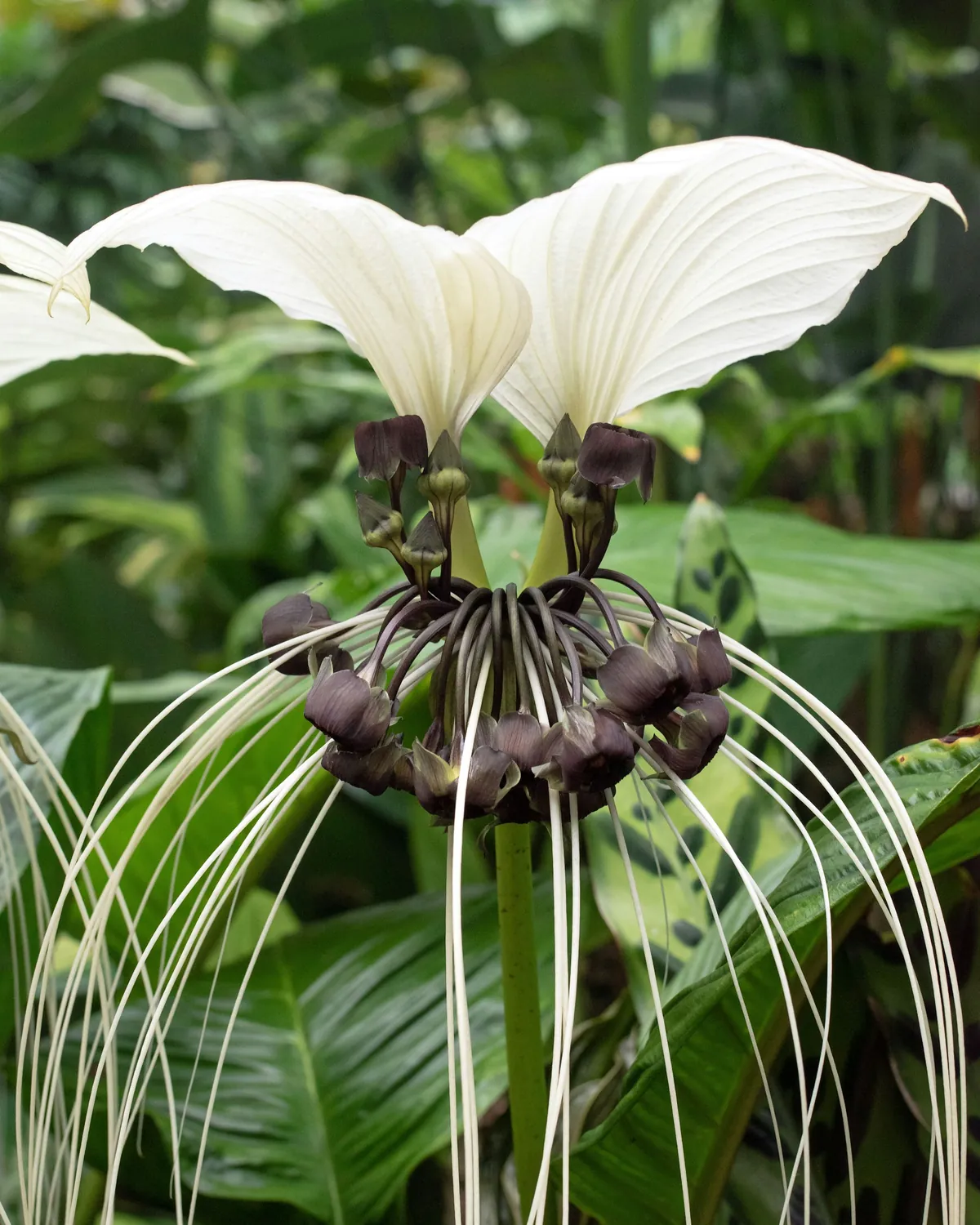
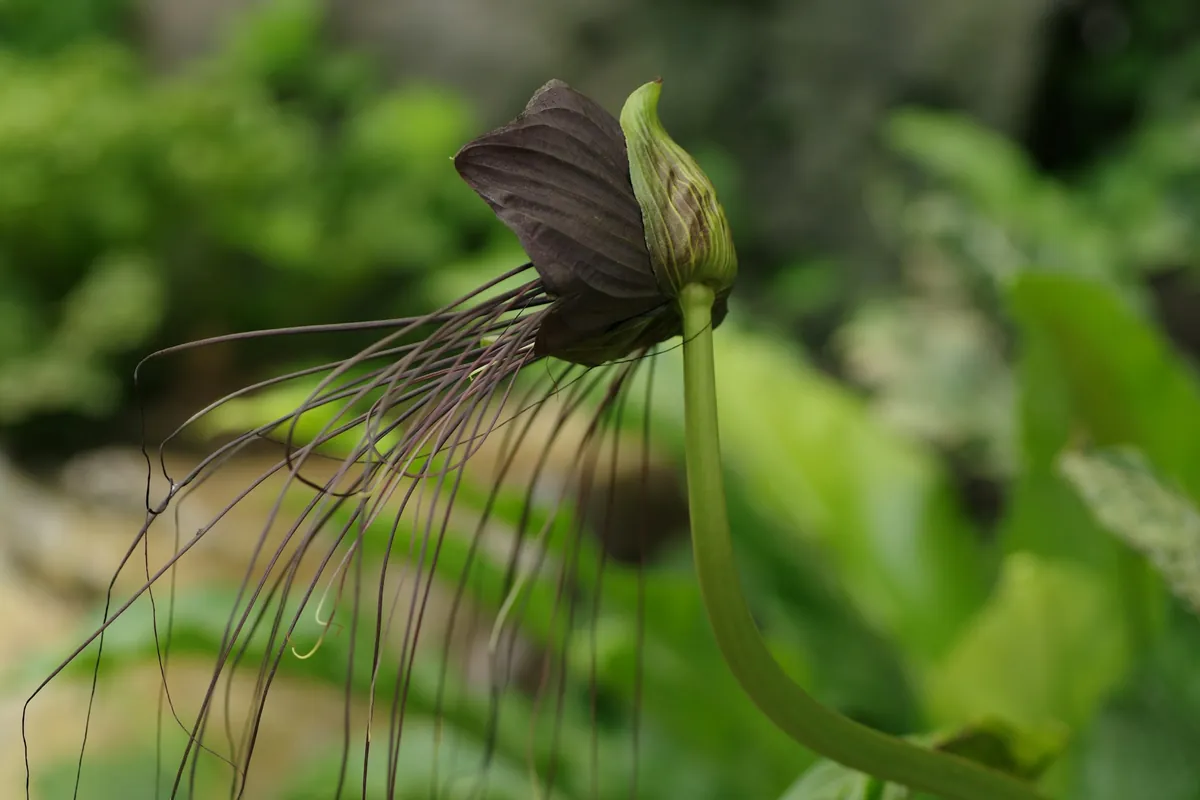
The black bat flower is one of the strangest blooms you can grow at home. Each flower head carries two broad, near-black bracts that spread like wings, a cluster of small purple flowers in the middle, and long, thread-like strands that hang down like whiskers. The effect looks like a bat in flight, which is how the plant got its common names: bat flower, bat plant, devil flower and cat’s whiskers.
Botanists call it Tacca chantrieri. Older books place it in its own family, Taccaceae, but most current references, including Singapore’s National Parks Board, now include it in Dioscoreaceae, the yam family. It is a clump-forming perennial herb that grows from a thick underground rhizome.
Mature plants reach about 2 to 3 feet tall, with glossy, pleated leaves 7 to 22 inches long. Flower stalks rise above the foliage in summer and fall, and the whiskers can reach about 8 inches.
Key takeaways
- Black bat flower (Tacca chantrieri) is a tropical understory plant from South and Southeast Asia.
- It is reliably hardy outdoors only in about USDA zones 10 to 11.
- It wants bright, indirect light or dappled shade, never strong midday sun.
- Keep it between 70 and 85°F, and protect it from anything below 55°F.
- Aim for 50% humidity or higher, with good air movement.
- Divide the rhizome in spring for the fastest new plants. Seed is slow.

Black Bat Flower vs White Bat Flower
Two Tacca species dominate the houseplant trade. They need the same care, but they look quite different in bloom. If you like unusual shapes in the garden, our guide to types of flowers covers many more forms worth knowing.
Black Bat Flower (Tacca chantrieri)
This is the classic “bat.” Its two outer bracts are dark maroon to almost black and spread sideways like wings. The small flowers open greenish-white and darken to purple or black as they age. This species is the easier and more common of the two.
White Bat Flower (Tacca integrifolia)
White bat flower carries two tall, upright inner bracts that stand up like rabbit ears above a darker purple center. In the forms sold to gardeners those bracts are white to pale lilac, with purple veins. Its leaves are longer, often 16 to 25 inches, and the plant tends to be a little larger overall. It pairs well with other pale bloomers, like the ones in our roundup of white flowers.
| Feature | Black bat flower | White bat flower |
|---|---|---|
| Botanical name | Tacca chantrieri | Tacca integrifolia |
| Main bracts | Dark maroon to black, spread like wings | Tall, upright, white to pale lilac, like rabbit ears |
| Whiskers | Up to about 8 inches | Up to about 7 inches |
| Plant height | About 2 to 3 feet | About 2 to 3 feet |
| Native range | Northeast India and southern China to Thailand and northern Malaysia | Southeast Asian forests, including Peninsular Malaysia and Singapore |
| Care | Warm, shaded, humid, evenly moist | Same as black bat flower |
Native Habitat and Hardiness Zones
Knowing where a plant grows in the wild tells you most of what it needs. According to the National Parks Board of Singapore, Tacca chantrieri grows on the floor of rainforest and monsoon forest from Assam and Bangladesh through southern China, Myanmar, Laos, Vietnam, Cambodia and Thailand to northern Peninsular Malaysia.
That is the forest understory: deep, moving shade, steady warmth, damp leaf litter and air that rarely dries out. Recreate those four things and the plant is far less fussy than its reputation.
In the US, bat flower grows outdoors year-round in about USDA zones 10 to 11, such as South Florida, coastal Southern California and Hawaii. Some growers succeed in sheltered zone 9b gardens, but a single frost or a long cold snap can kill the leaves and rot the rhizome. Everywhere else, treat it as a container plant that summers outside and winters indoors. If you want a shade bloomer that stays in the ground through cold winters, columbine is a far hardier choice.
How to Grow Black Bat Flower
Whether it lives in a shady bed or a pot on the porch, black bat flower care comes down to six factors. Get light and humidity right first, because those two cause most failures.
Light and Shade
Outdoors, plant it in dappled shade under trees or on the north or east side of a building. Indoors, give it bright, indirect light, such as a spot a few feet back from an east window. A little soft morning sun is fine. Hot afternoon sun scorches the leaves within days, leaving pale, crispy patches.
Temperature
Bat flower grows best between about 70 and 85°F. It stalls below 60°F and suffers below 55°F. Bring container plants inside before nights fall into the 50s. Keep them away from cold drafts and air conditioning vents.
Humidity
Aim for at least 50% relative humidity, and 60 to 80% is better. Dry indoor air is the main reason house-grown plants refuse to bloom. A room humidifier works best. Pebble trays and grouping plants help a little. If you mist, do it in the morning, and keep air moving with a small fan to prevent leaf spots.
Soil and Potting Mix
The roots need moisture and air at the same time, so use a loose, chunky, organic mix. University of Florida IFAS suggests 50% pine bark, 40% peat moss and 10% sand. An orchid bark and peat mix with a handful of perlite works too. Slightly acidic soil suits it. Outdoors, dig plenty of compost or leaf mold into the bed and avoid heavy clay.
Choose a wide, shallow pot with drainage holes. The rhizome spreads sideways more than down, so a deep pot just holds extra wet soil around the roots.
Watering
During spring and summer growth, keep the mix evenly moist, like a wrung-out sponge. Water when the top half inch starts to dry, then let the excess drain away. Never leave the pot standing in water. Use room-temperature water, as cold water shocks tropical roots.
Feeding
Feed lightly and often while the plant is growing. A balanced liquid fertilizer or an orchid fertilizer at half strength every two weeks from spring to late summer works well. Stop feeding in fall and winter. Too much fertilizer burns the fine roots and browns the leaf tips.
Growing Bat Flower Indoors or in a Greenhouse
Most US gardeners grow bat flower as a houseplant or greenhouse plant. A bright bathroom or kitchen often suits it better than a living room because the air is more humid.
In a greenhouse, it fits right in with orchids and ferns. The Royal Horticultural Society recommends a heated greenhouse kept at 55°F or more, with bright, filtered light, free watering through the year and regular misting in summer.
- Move pots outside only when nights stay above 60°F, and set them in full shade at first.
- Bring them back in before nights drop into the 50s in fall.
- Repot every one to three years in spring, just as new growth starts. Trim away old, soft or decaying sections of rhizome.
Expect flowers from early summer into fall on a healthy, mature plant. Leave the blooms on the plant to enjoy them. UF/IFAS notes they wilt quickly once cut, so bat flower is not one for the cut flower garden.
Winter Care and Dormancy
Bat flower does not need a cold rest, but it slows down in winter as days shorten. What happens next depends on how warm you keep it.
- Kept at 65 to 75°F: it usually stays evergreen and simply grows slowly. Water a little less and stop feeding.
- Kept cooler, around 60°F: it may drop some or all of its leaves and rest as a rhizome. Let the top inch of mix dry before watering, but never let it dry out completely.
- In spring: new shoots appear as light and warmth return. Restart regular watering and feeding once you see them.
Overwatering a resting plant is the most common winter mistake. A leafless rhizome uses very little water, and soggy, cool mix rots it quickly. If you enjoy keeping tender plants going over winter, the same rhythm of less water and no food works for amaryllis after it blooms.
How to Propagate Black Bat Flower
You can propagate bat flower by dividing the rhizome or by sowing seed. Division is faster and gives you a flowering-size plant much sooner.
Rhizome Division
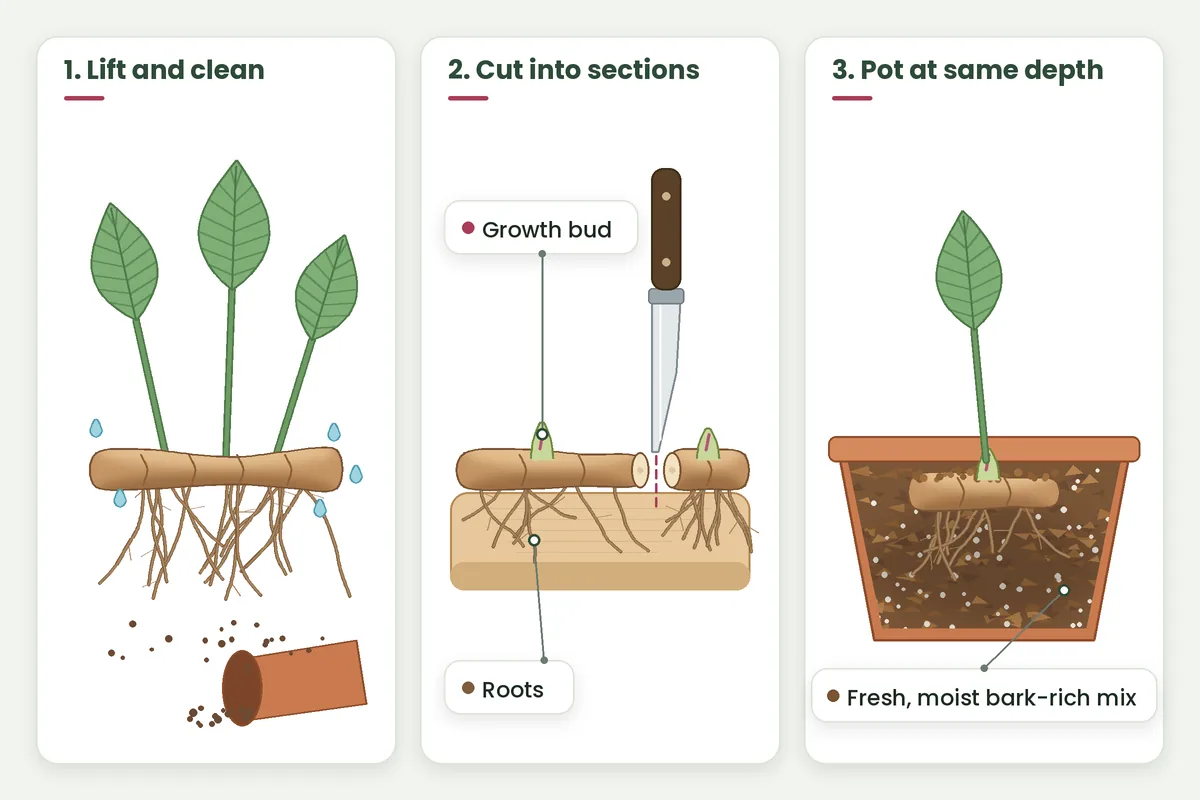
- Divide in spring, when you repot and new growth is just starting.
- Slide the plant out and gently wash or shake the mix from the rhizome.
- Cut it into sections with a clean, sharp knife. Each piece needs at least one growth bud and some roots.
- Let the cuts dry for a few hours, then dust them with sulfur or cinnamon if you like.
- Pot each section at the same depth it grew before, in fresh, moist mix.
- Keep divisions warm, in shade and on the dry side of moist until new leaves appear.
Growing From Seed
Flowers are mostly self-pollinating, so mature plants sometimes set ribbed seed pods full of small brown seeds. Fresh seed gives the best results, since older seed often fails. Sow it on the surface of a fine, moist mix, cover the tray to hold humidity and keep it at 72 to 81°F, the range the RHS gives. Germination is slow and uneven, often taking several weeks to a few months. Seedlings then take a few years to reach flowering size, so patience matters more here than with most flowers.
Buy seed only from specialist sellers. Cheap online listings for “bat flower seeds” are often old, non-viable or not Tacca at all.
Common Bat Flower Problems
Healthy bat flowers are rarely bothered by disease. Most trouble comes from dry air, cold or wet roots, so check those first when something looks wrong.
- Brown, crispy leaf edges: humidity is too low or the plant is drying out between waterings. Raise humidity and water more evenly.
- Pale or scorched patches: too much direct sun. Move it to brighter shade.
- Yellow, limp leaves and a soft base: root or rhizome rot from soggy, cold mix. Unpot, cut away rotten tissue, and repot in fresh, airy mix.
- No flowers: usually low humidity, too little light, or a plant that is still young or too recently divided.
- Spider mites and broad mites: fine speckling or distorted new growth in dry air. Shower the leaves and use insecticidal soap.
- Mealybugs and scale: white fluff or small brown bumps on stems and leaf undersides. Wipe off and treat with horticultural oil.
- Slugs and snails: ragged holes in outdoor plants. Hand-pick at night or use a bait safe for pets.
- Gray mold (Botrytis): fuzzy gray rot on old flowers in still, damp air. Remove spent blooms and improve air flow.
Is Black Bat Flower Toxic?
Reliable toxicity data for bat flower is limited. The National Parks Board of Singapore notes that it contains taccalonolides, compounds that researchers have studied for their effects on cell division. It is not known to be toxic to humans but may cause an allergic reaction if eaten, and it may be toxic to cats and dogs.
Keep bat flower out of reach of pets and small children as a sensible precaution. If a pet chews the plant and shows vomiting, drooling or lethargy, call your vet. For a pet-friendly flower with a confirmed non-toxic listing, try celosia instead.
Black Bat Flower FAQs
Is black bat flower hard to grow?
It is easier than its reputation once you match its forest home. Most failures come from dry indoor air, cold rooms or soggy soil. Give it bright shade, temperatures between 70 and 85°F, humidity of 50% or more and a loose, evenly moist mix, and a healthy plant grows steadily and blooms each summer.
Can black bat flower grow outside?
Yes, in about USDA zones 10 to 11, such as South Florida, coastal Southern California and Hawaii. Plant it in dappled shade with rich, moist, well-drained soil. In colder zones, grow it in a pot outdoors in summer and bring it inside before night temperatures fall below about 55 to 60°F.
How long does black bat flower bloom?
A mature plant can flower from early summer into fall, sending up several flower stalks over the season. Each flower head stays attractive for a few weeks before it fades. Leave the blooms on the plant, because they wilt quickly once cut and do not last in a vase.
Why is my bat flower not blooming?
The usual causes are low humidity, too little light, or a plant that is still young or was recently divided. Move it to brighter, indirect light, raise humidity above 50% and feed lightly every two weeks in spring and summer. Plants grown from seed can take a few years to reach flowering size.
Does black bat flower go dormant in winter?
It does not need a cold rest, but it slows down as days shorten. Kept at 65 to 75°F, it usually stays evergreen. In a cooler spot near 60°F, it may drop leaves and rest as a rhizome. Water sparingly while it rests, stop feeding and resume both when new shoots appear in spring.
What is the difference between black and white bat flower?
Black bat flower, Tacca chantrieri, has dark maroon to black bracts that spread sideways like wings. White bat flower, Tacca integrifolia, has tall upright bracts that are white to pale lilac and stand up like rabbit ears. Both are tropical Asian forest plants and need the same warm, shaded, humid care.
Related flower guides
More guides you might enjoy.