Angel Trumpet Flower: How to Grow Brugmansia Safely
Angel trumpet flower (Brugmansia) is a tropical shrub with huge, hanging, fragrant blooms. Learn how to grow it in the ground or in pots, prune above the Y, overwinter it, root cuttings and handle this highly toxic plant safely.

The angel trumpet flower (Brugmansia) is a tropical South American shrub with huge, hanging, fragrant trumpets. Grow it in the ground in about USDA zones 9 to 11, or in a large pot that winters indoors elsewhere. Give it sun, rich soil and plenty of water and food in summer. Every part is highly toxic, so wear gloves and keep it away from children and pets.
What Is an Angel Trumpet Flower?
The angel trumpet flower is one of the most dramatic plants you can grow in a pot. Each bloom is a long, flared trumpet that hangs straight down from the branches. A mature shrub can carry dozens at once, and many types fill the evening air with a sweet scent.
Botanists call it Brugmansia. It belongs to the nightshade family, Solanaceae, along with tomatoes, peppers and potatoes. The NC State Extension Plant Toolbox describes a genus of seven species of tropical evergreen shrubs and small trees from South America. You may also see it sold as tree datura, because it was once grouped with Datura.
Flowers are trumpet or funnel shaped, five lobed and often close to a foot long. Leaves are large, soft and oval. In frost-free gardens, plants can grow into small trees up to 35 feet tall, while container plants usually stay between 6 and 15 feet.
There is one serious catch. Angel’s trumpet is among the most toxic ornamental plants you can grow. That does not mean you cannot enjoy it. It does mean it needs a safe spot and careful handling, which this guide covers first.
Key takeaways
- Angel trumpet (Brugmansia) is a woody South American shrub with large, hanging, fragrant flowers.
- All parts are highly toxic. They contain scopolamine, atropine and hyoscyamine.
- It grows outdoors year-round in about USDA zones 9 to 11. Elsewhere, grow it in a pot and bring it in before frost.
- It is a heavy feeder and a heavy drinker during summer growth.
- Flowers form only on growth above the first main fork, the “Y,” so never prune below it.
- Stem cuttings root easily in water or moist mix.

Angel Trumpet Flower Safety: Is Brugmansia Poisonous?
Yes. Every part of the plant is poisonous, including the flowers, leaves and seeds. Brugmansia contains tropane alkaloids, mainly scopolamine, atropine and hyoscyamine. These compounds block nerve signals in the body, and small amounts can cause serious harm.
NC State Extension lists the toxicity as high and flags the plant as a problem for children. Possible symptoms include:
- Hallucinations and confusion
- Dry mouth and fever
- Dilated pupils and blurred vision
- A fast pulse and raised blood pressure
- Muscle weakness and, in severe cases, paralysis
Pets are at risk too. Pet Poison Helpline lists angel’s trumpet as toxic to dogs and cats and notes that all parts of the plant are poisonous. Treat it as dangerous to horses and any other animal that might chew it too.
Safe Handling Rules
- Wear gloves when you prune, take cuttings, repot or deadhead.
- Wash your hands well afterward, even if you wore gloves.
- Never touch your eyes while handling the plant. Sap rubbed into an eye can widen the pupil and blur vision.
- Never eat, brew or smoke any part of the plant. Do not use the flowers to decorate food or drinks.
- Site it carefully. Keep pots away from play areas, pet runs and paths where small children walk.
- Clean up fallen flowers and leaves so pets and toddlers cannot pick them up.
- Bag prunings for the trash rather than leaving them where animals graze.
If a person may have eaten any part of the plant, call Poison Control at 1-800-222-1222 right away, or 911 if they are very drowsy, confused or struggling to breathe. Do not wait for symptoms to appear. If a pet chews the plant, call your vet or an animal poison line such as the ASPCA Animal Poison Control Center at (888) 426-4435 or Pet Poison Helpline at (855) 764-7661. These services may charge a consultation fee.
If your household includes curious toddlers or a dog that chews everything, it may be wiser to skip angel trumpet for now. A cheerful, pet-safer choice such as celosia gives you summer color without the same worry.
Brugmansia vs Datura: How to Tell Them Apart
Both Brugmansia and Datura are sold as “angel trumpet,” which causes a lot of confusion. They are close relatives with similar trumpet flowers, and both are highly toxic. The easiest way to tell them apart is to look at which way the flowers point.
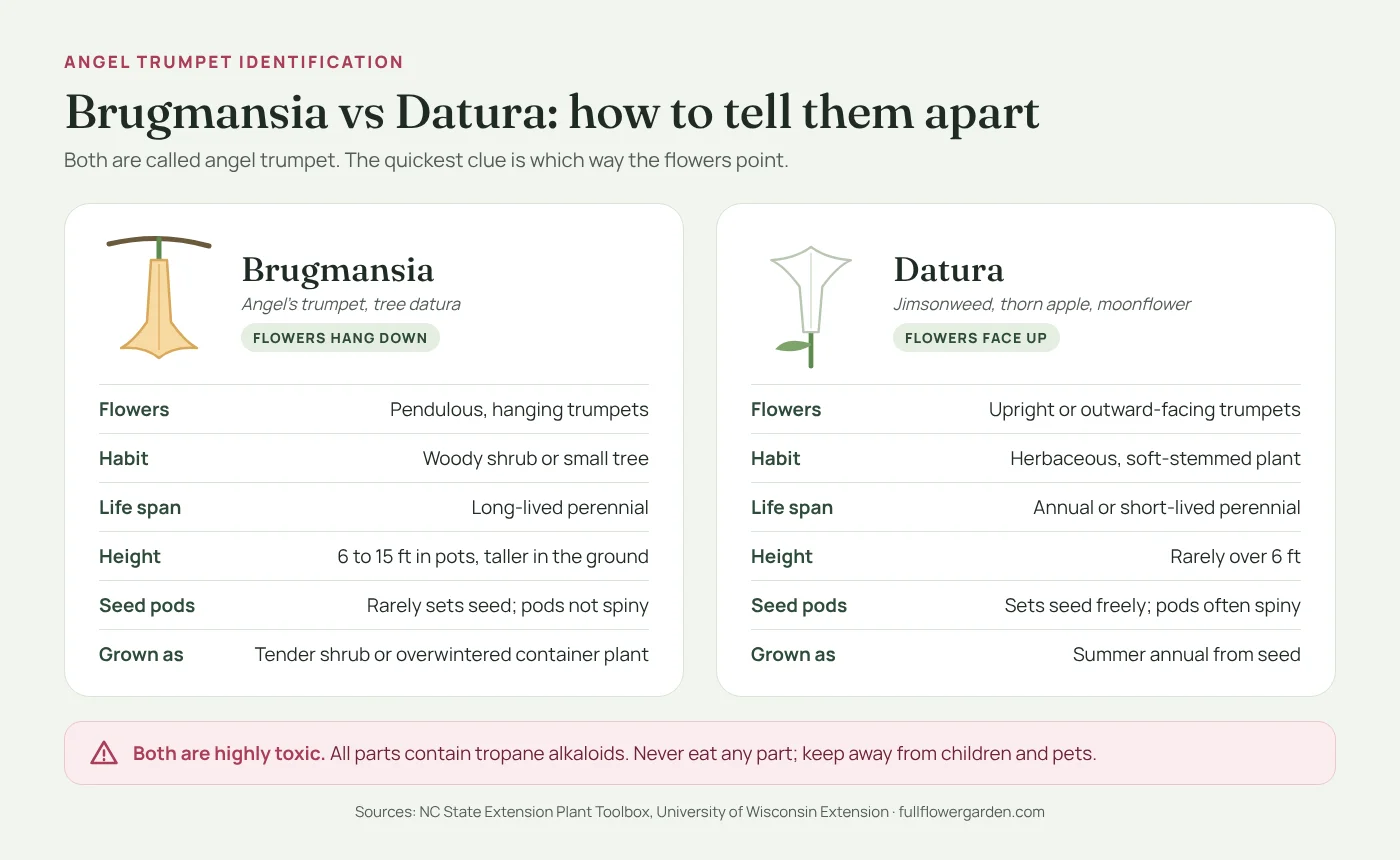
- Brugmansia flowers hang down. The plant is a long-lived, woody shrub or small tree. It rarely sets seed.
- Datura flowers face upward or outward. The plant is a soft-stemmed annual or short-lived perennial, rarely over 6 feet tall. It sets seed freely, often in spiny pods, which explains names like thorn apple.
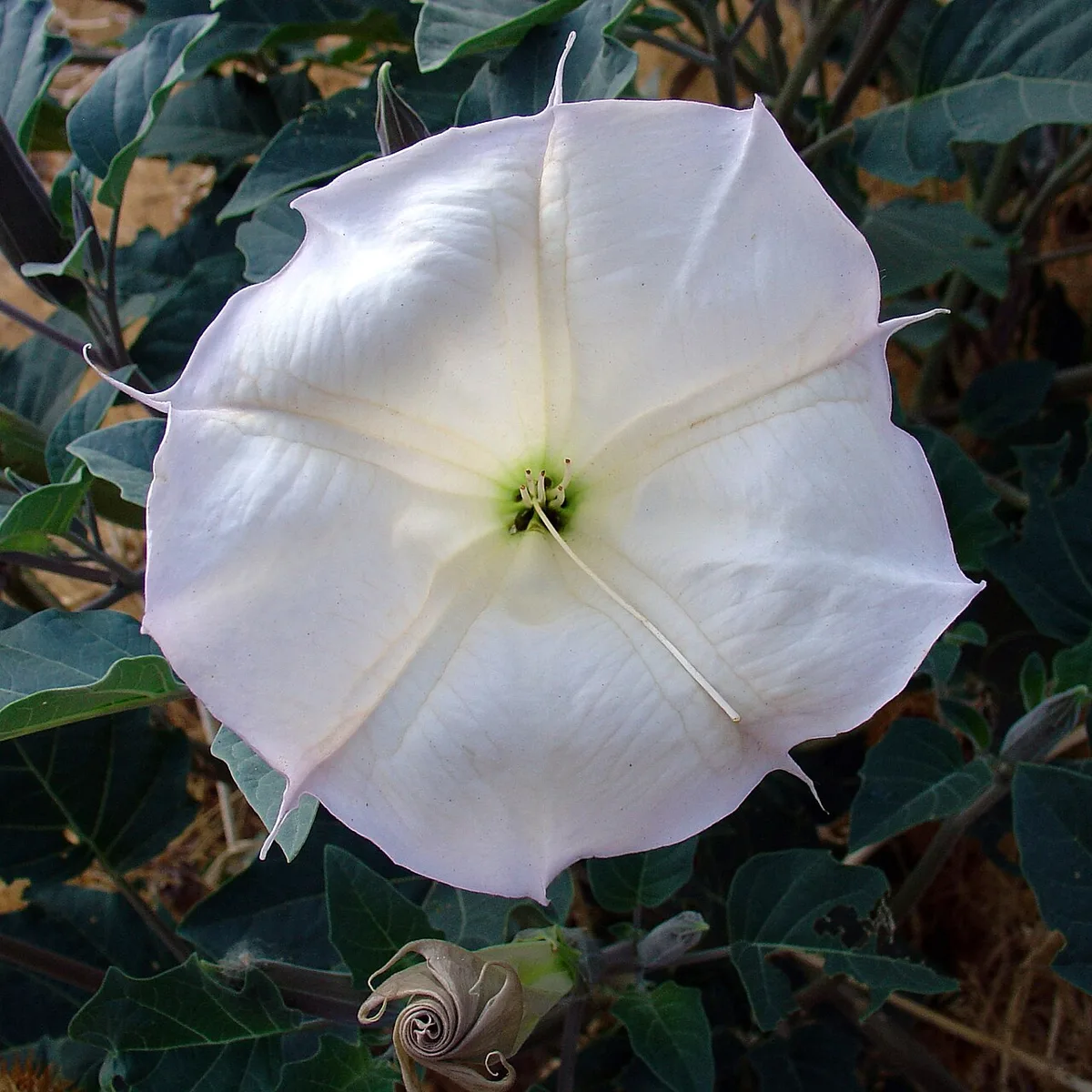
Most of the care advice below is for Brugmansia. Datura is usually grown from seed as a summer annual and needs much less attention. If you like big white blooms, our list of white flowers includes safer options for beds near the house.
Angel Trumpet Colors and Varieties
Angel trumpets come in white, cream, yellow, gold, orange, peach, pink and red. Many flowers open one shade and slowly deepen to another over a day or two. Some varieties have double or even triple flowers, with one trumpet nested inside another.
According to University of Wisconsin Extension, individual blooms range from about 4 to 24 inches long, depending on the species and cultivar. Fragrance varies just as widely, from none at all to strong and sweet.
| Species | Typical flower color | Notes |
|---|---|---|
| Brugmansia suaveolens | White, cream, pale yellow or pink | Widely grown; often strongly scented in the evening |
| Brugmansia × candida | White to cream, sometimes pink or apricot | A common garden hybrid with long, hanging trumpets |
| Brugmansia aurea | White to golden yellow | One of the parents of many modern hybrids |
| Brugmansia versicolor | Pale apricot, aging darker | Has some of the largest flowers in the genus |
| Brugmansia arborea | White | Smallest flowers; they nod rather than hang straight down |
| Brugmansia sanguinea | Red, orange and yellow | The only true red species, with no fragrance |

Many plants sold at garden centers are hybrids, so a named cultivar may not match a species description exactly. For more unusual shapes and colors to plan around, browse our guide to types of flowers.
Why Angel Trumpet Smells Strongest at Night
University of Florida IFAS Extension notes that angel trumpet fragrance is strongest at night. The scent helps attract pollinating moths, which fly after dark. On a warm summer evening, a single large plant can perfume a whole patio.
Place pots where you can enjoy that evening scent, such as beside a patio seat that children and pets do not use. With enough light and temperatures above about 60°F, a healthy plant keeps flowering for months.
Hardiness Zones and Where to Grow It
Angel trumpet is frost tender. It grows as a year-round shrub in roughly USDA zones 9 to 11, such as Central and South Florida, parts of the Gulf Coast, coastal California and Hawaii. A light frost may burn the leaves, but established plants in the ground often regrow from the base.
NC State Extension notes that plants can survive in parts of zone 8 and sheltered zone 7b in many years. They die back to the ground and usually return in spring when piled with leaves or mulch. That return is not guaranteed, so take cuttings as insurance.
Everywhere colder, grow angel trumpet in a large container. It spends summer outdoors and winter in a garage, basement or bright room. This approach also makes it easier to place the plant safely, away from children and pets.
How to Grow Angel Trumpet Flower: Brugmansia Care Basics
Good brugmansia care comes down to five things: light, soil, water, food and room for roots. Get these right in summer and the plant will reward you with wave after wave of flowers.
Light
In northern gardens with mild summers, angel trumpet blooms best in full sun. In the hot South and Southwest, give it morning sun and afternoon shade, which protects the large leaves from scorching. If leaves look pale or wilt hard every afternoon even when the soil is moist, move the plant to a little more shade.
Soil and Containers
Plant in rich, moist, well-drained soil with plenty of organic matter. In containers, use a quality potting mix with added compost. The roots must never sit in standing water.
Choose a big, heavy pot with drainage holes. Brugmansia has a large root system and fills small pots quickly, which leads to constant wilting. Move young plants up a pot size each time the roots fill the current one. A wide, weighted pot also keeps a tall, top-heavy plant from blowing over.
Watering
Angel trumpets use a remarkable amount of water in summer. University of Wisconsin Extension notes that large container plants may need watering two to three times a day in hot weather. Drooping leaves are the plant’s way of asking for a drink, and it usually perks up soon after watering.
Water deeply until it runs from the drainage holes, then let the excess drain away. In winter, the need drops sharply. Dormant plants only need enough water to keep the soil barely moist.
Fertilizing
Brugmansia is a heavy feeder. During the growing season, feed with a water-soluble fertilizer about once a week. University of Wisconsin Extension notes that container plants can take fertilizer up to twice a week in summer. Yellowing lower leaves in midsummer are often a sign of hunger.
Stop feeding in fall as you prepare to bring the plant in. A resting plant in winter needs little or no fertilizer.
Pruning Above the “Y” for More Flowers
Pruning is where many angel trumpet growers go wrong. A young plant grows a single straight trunk at first. Eventually, often at about 2.5 to 5 feet tall, that trunk splits into two or three branches, forming a Y. Flowers form only on growth above that first main fork.
If you cut below the Y, the plant has to grow a new trunk and fork before it blooms again, which can cost you a whole season. Follow these rules:
- Wear gloves, and clean your pruners before and after.
- Leave the Y itself intact and make every cut on the branches above it.
- Shape the plant and reduce its height by cutting branches above the fork.
- Remove weak, crossing or damaged stems at any time.
- Do heavier pruning in fall before moving pots indoors, or in early spring.
- Use the pruned stems as cuttings to make new plants.
Flowering branches also look different. Leaves on flowering wood tend to be lopsided at the base, with one side of the leaf meeting the stem lower than the other. Leaves on young, non-flowering growth are more even.
Overwintering Angel Trumpet in Pots
In zones colder than 9, overwintering is the key to big plants and early flowers. A plant that survives winter starts the next season far ahead of a new cutting. The same idea of saving tender plants indoors works for black bat flower, which also lives in pots in most of the country.
Before the first frost, prune the plant to a manageable size above the Y. Then check it closely for pests, especially on leaf undersides, and treat any you find before it comes inside. Choose one of two methods:
Keep It Growing
Move the pot into a sunroom, greenhouse or a bright window in a cool room. Water when the top inch of soil is dry and skip fertilizer. The plant may drop some leaves and grow slowly, but it can keep its foliage and sometimes even blooms.
Let It Go Dormant
This is the easiest option. Put the pot in a cool, dark place such as a basement or attached garage that stays above freezing. A spot around 41 to 50°F works well. Most leaves will drop. Check the soil every few weeks and give just enough water to keep it from drying out completely.
- In late winter, move the plant into brighter light and start watering a little more.
- Once new leaves appear, begin light feeding.
- After all danger of frost has passed, move it outside to a shady spot first.
- Over a week or so, increase sun and wind exposure gradually, then return to the normal care routine.
If you already save other tender plants over winter, such as garden mums or amaryllis bulbs, an angel trumpet fits easily into the same routine.
How to Propagate Brugmansia From Cuttings
Angel trumpets root so easily from cuttings that most growers never buy a second plant. Cuttings also come true to the parent, while seed from hybrids does not. Wear gloves the whole time, because you will be handling cut stems and sap.
- Take cuttings while the plant is actively growing. Spring and summer give the best results.
- Choose semi-hardwood stems that are turning from green to brown, at least as thick as a finger.
- Cut pieces 6 to 8 inches long.
- Remove all leaves and buds except the small topmost leaves.
- Stand the cuttings in 2 to 3 inches of water in a bright, warm spot, changing the water every day or two. Or insert about a third of each cutting into moist potting mix.
- Pot water-rooted cuttings once the roots are several inches long, usually within a few weeks.
- Let the soil get nearly dry before the next watering to prevent rot, until new growth is strong.
You can also grow species from seed, but it is slower and hybrids will not come true. Seeds are toxic, so store them out of reach of children.
Common Pests and Problems
Healthy angel trumpets have few serious problems outdoors. Pests usually build up on plants kept indoors over winter, and University of Wisconsin Extension notes that pressure rises in late winter and early spring as the days lengthen.
- Whiteflies: clouds of tiny white insects fly up when you brush the leaves. Spray leaf undersides with insecticidal soap and repeat regularly.
- Spider mites: fine speckling and webbing, worst in dry indoor air. Rinse the leaves and use insecticidal soap or horticultural oil.
- Aphids and mealybugs: clusters of soft insects on new growth and stems. Wash off with a strong spray of water, then treat with insecticidal soap.
- Caterpillars: large holes in leaves and chewed flowers outdoors. Hand-pick them while wearing gloves.
- Yellow leaves: usually hunger, too little water in summer or normal leaf drop in winter. Feed and water more consistently while it is growing.
- Root rot: constant wilting in wet soil and a soft stem base. Let the soil dry slightly before watering, especially in cool weather.
- Viruses: mottled or distorted leaves. Clean pruners between plants, since viruses spread on tools.
- No flowers: the plant may be too young, pruned below the Y, short of light or underfed.
Heavily infested plants often drop their leaves, but they usually regrow them quickly once moved outdoors and fed. Do not compost pruned stems or leaves where pets or children could reach the pile.
Angel Trumpet Flower FAQs
Is angel trumpet flower poisonous to touch?
Touching the plant is not usually dangerous, but its sap can be absorbed if it reaches your eyes or mouth. Sap rubbed into an eye can widen the pupil and blur vision. Wear gloves when pruning or taking cuttings, wash your hands afterward and never touch your face while handling it.
What should I do if a child or pet eats angel trumpet?
For a person, call Poison Control at 1-800-222-1222 right away, or 911 if they are very drowsy, confused or struggling to breathe. Do not wait for symptoms. For a pet, call your vet or an animal poison line such as the ASPCA Animal Poison Control Center or Pet Poison Helpline immediately.
What is the difference between Brugmansia and Datura?
Brugmansia flowers hang down, while Datura flowers face upward or outward. Brugmansia is a long-lived woody shrub or small tree that rarely sets seed. Datura is a soft-stemmed annual or short-lived perennial that sets seed freely, often in spiny pods. Both are called angel trumpet, and both are highly toxic.
Can angel trumpet grow in a pot?
Yes. Angel trumpet grows very well in large containers, which is how most gardeners outside zones 9 to 11 grow it. Use a big, heavy pot with drainage holes and rich potting mix. Water and feed often in summer, then move it indoors before the first frost.
Why is my angel trumpet not blooming?
The most common causes are a plant that is still too young, pruning below the first main fork, too little light or too little fertilizer. Flowers form only on growth above the Y. Give the plant more sun, feed it regularly in summer and prune only above the fork.
When does angel trumpet bloom?
Angel trumpet usually blooms from summer into fall, often in repeated flushes. In warm climates, plants can bloom for much of the year when temperatures stay above about 60°F and light is good. Container plants that were overwintered bloom earlier than new cuttings.
How do you overwinter angel trumpet?
Before the first frost, prune above the Y, check for pests and move the pot indoors. Either keep it growing in a bright, cool room or let it go dormant in a dark spot around 41 to 50°F. Water only enough to keep the soil from drying out completely, and move it outside after frost danger passes.
Does angel trumpet attract hummingbirds?
The strong evening fragrance mainly attracts night-flying moths, which are its key pollinators. NC State Extension also lists hummingbirds among its visitors. Most of the scent and pollinator activity, however, happens after dark.
Related flower guides
More guides you might enjoy.


Pingback: May Birth Flower: Lily of the Valley and Hawthorn Meaning